af5f9cf
Caliptra - FMC Specification v2.1
Spec Version: 0.9
Scope
Caliptra is an open-source Hardware Root of Trust for Measurement (RTM). This document is the architecture specification for Caliptra First Mutable Code (FMC). As an architecture specification for FMC, this document describes the following topics:
- Provide high level requirements
- Describe FMC load and measurement flow
- Describe FMC functionality
- Define FMC boot flows
Glossary
| Term | Description |
|---|---|
| DCCM | Data Closely Coupled Memory |
| DICE | Device Identifier Composition Engine |
| FHT | Firmware Handoff Table |
| FMC | First Mutable Code |
| FW | Firmware |
| ICCM | Instruction Closely Coupled Memory |
| PCR | Platform Configuration Register |
| RoT | Root of Trust |
| RT | Runtime |
| RTM | Root of Trust for Measurement |
| TCI | Trusted Component Identifier |
| SVN | Security Version Number |
Overview
First Mutable Code (FMC) is the first field-updatable firmware module in the Caliptra boot sequence. It is loaded, cryptographically verified, and executed by the Caliptra ROM.
Pre-conditions / assumptions
It is assumed that the Caliptra ROM has already performed a series of steps to prepare the Caliptra environment before calling the FMC entry point. The following is a brief overview of those expectations. Further details can be found in the Caliptra ROM Specification.
- ROM is responsible for initializing its ROM-based FIPS Crypto Module
(Note that this requirement is dependent on the chosen FIPS boundary. It only applies if there is a discrete FIPS ROM module that is isolated from the rest of the ROM. This is not expected to be the case for the first generation of Caliptra.) - ROM is responsible for locating the image containing all of Caliptra’s mutable firmware and loading it into ICCM.
- ROM is responsible for authentication of the Manifest and each individual FW Module loaded to ICCM.
- ROM is responsible for ensuring that the Anti-Rollback Protection is enforced for all mutable firmware modules.
- ROM is responsible for creating Caliptra’s initial DICE identity and extending it with measurements of the FMC Module.
- ROM jumps to the Caliptra FMC entry point.
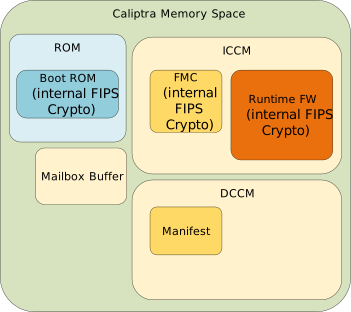
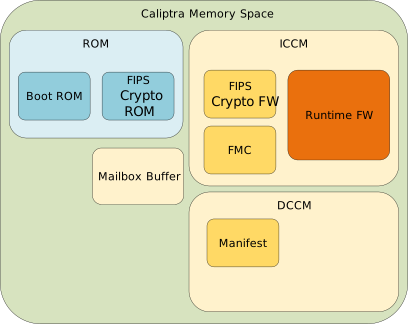
At the time the Caliptra FMC entry point is executed, the Caliptra memory space will look like one of the following diagrams (dependent upon selected FIPS Crypto boundary):
Current POR: All Caliptra FW in FIPS boundary
Alternate: Caliptra ROM and FW each have discrete FIPS modules
Alternate: Caliptra ROM implements FIPS Module used by all other components

FMC responsibilities
FMC can be thought of as essentially a small, mutable extension of the ROM. Its primary purpose is to bridge execution from the immutable ROM code, prepare the environment for the main runtime firmware, and then execute that runtime firmware. As such, the code should be kept to the bare minimum needed to perform that task. “Feature-creep” in this area is undesirable, and all efforts shall be made to avoid it.
- FMC must initialize the FW-based FIPS Crypto Module that is loaded alongside it. This initialization must be completed before any cryptographic operations can
be performed.
(Note that this requirement is dependent on the chosen FIPS boundary. It only applies if there is a discrete FIPS firmware module that is loaded separately from the FMC FW module. This is not expected to be the case for the first generation of Caliptra.) - FMC must measure the Runtime Firmware Module using services from the FIPS Crypto Module.
- FMC must extend the Caliptra DICE identity to the Runtime Firmware Module using FIPS Crypto services, generating artifacts CDIRT, AliasKeyPairRT, and certifying PublicKeyRT.
- At any time during its flow, the FMC MAY be required to execute a workaround for an RTL or ROM bug that was discovered after Caliptra hardware was frozen. The nature, feasibility, and timing of such a workaround will be dependent on the specific details of the bug.
- FMC must make the CDIRT, AliasKeyPairRT, and CertRT available to the Runtime Firmware Module, while making its own CDIFMC and PrivateKeyFMC unavailable.
- FMC must execute the Runtime Firmware Module.
Firmware handoff table
The Firmware Handoff Table is a data structure that is resident at a well-known location in DCCM. It is initially populated by ROM and modified by FMC as a way to pass parameters and configuration information from one firmware layer to the next.
Table revisions with the same Major Version must remain backward compatible (i.e. fields may be added to the end of the table, or fields may be deprecated, but fields may not be changed or removed). Table revisions with different Major Versions may or may not be compatible.
Note: All fields are little-endian unless otherwise specified.
| Field | Size (bytes) | Written By | Description |
|---|---|---|---|
| fht_marker | 4 | ROM | Magic Number marking start of FHT. Value must be 0x54484643, ‘CFHT’ when viewed as little-endian ASCII. |
| fht_major_ver | 2 | ROM | Major version of FHT. |
| fht_minor_ver | 2 | ROM, FMC | Minor version of FHT. Initially written by ROM but may be changed to a higher version by FMC. |
| manifest_load_addr | 4 | ROM | Physical base address of Manifest in DCCM SRAM. |
| fips_fw_load_addr_hdl | 4 | ROM | Handle of base address of FIPS Module in ROM or ICCM SRAM. May be 0xFF if there is no discrete module. |
| fmc_cdi_kv_hdl | 4 | ROM | Handle of FMC CDI value in the Key Vault. Value of 0xFF indicates not present. |
| fmc_priv_key_ecdsa_kv_hdl | 4 | ROM | Handle of FMC Alias ECDSA Private Key in the Key Vault. |
| fmc_keypair_seed_mldsa_kv_hdl | 4 | ROM | Handle of FMC Alias MLDSA Key Pair Generation Seed in the Key Vault. |
| fmc_pub_key_ecdsa_x_dv_hdl | 4 | ROM | Handle of FMC Alias ECDSA Public Key X Coordinate in the DCCM datavault. |
| fmc_pub_key_ecdsa_y_dv_hdl | 4 | ROM | Handle of FMC Alias ECDSA Public Key Y Coordinate in the DCCM datavault. |
| fmc_pub_key_mldsa_dv_hdl | 4 | ROM | Handle of FMC Alias MLDSA Public Key in the DCCM datavault. |
| fmc_cert_sig_ecdsa_r_dv_hdl | 4 | ROM | Handle of FMC Certificate ECDSA Signature R Component in the DCCM datavault. |
| fmc_cert_sig_ecdsa_s_dv_hdl | 4 | ROM | Handle of FMC Certificate ECDSA Signature S Component in the DCCM datavault. |
| fmc_cert_sig_mldsa_dv_hdl | 4 | ROM | Handle of FMC Certificate MLDSA Signature in the DCCM datavault. |
| rt_cdi_kv_hdl | 4 | FMC | Handle of RT CDI value in the Key Vault. |
| rt_priv_key_ecdsa_kv_hdl | 4 | FMC | Handle of RT Alias ECDSA Private Key in the Key Vault. |
| rt_keygen_seed_mldsa_kv_hdl | 4 | FMC | Handle of RT Alias MLDSA Key Generation Seed in the Key Vault. |
| ldevid_tbs_ecdsa_addr | 4 | ROM | Local Device ID ECDSA TBS Address. |
| fmcalias_tbs_ecdsa_addr | 4 | ROM | FMC Alias TBS ECDSA Address. |
| ldevid_tbs_mldsa_addr | 4 | ROM | Local Device ID MLDSA TBS Address. |
| fmcalias_tbs_mldsa_addr | 4 | ROM | FMC Alias TBS MLDSA Address. |
| ldevid_tbs_ecdsa_size | 2 | ROM | Local Device ID ECDSA TBS Size. |
| fmcalias_tbs_ecdsa_size | 2 | ROM | FMC Alias TBS ECDSA Size. |
| ldevid_tbs_mldsa_size | 2 | ROM | Local Device ID MLDSA TBS Size. |
| fmcalias_tbs_mldsa_size | 2 | ROM | FMC Alias TBS MLDSA Size. |
| pcr_log_addr | 4 | ROM | PCR Log Address. |
| pcr_log_index | 4 | ROM | Last empty PCR log entry slot index. |
| meas_log_addr | 4 | ROM | Measurement Log Address. |
| meas_log_index | 4 | ROM | Last empty Measurement log entry slot index. |
| fuse_log_addr | 4 | ROM | Fuse Log Address. |
| rt_dice_pub_key_ecdsa | 96 | FMC | RT Alias DICE ECDSA Public Key. |
| rt_dice_pub_key_mldsa_dv_hdl | 4 | FMC | RT Alias DICE MLDSA Public Key in the DCCM datavault. |
| rt_dice_sign_ecdsa | 96 | FMC | RT Alias DICE ECDSA signature. |
| rt_dice_sign_mldsa_dv_hdl | 4 | FMC | RT Alias DICE MLDSA signature in the DCCM datavault. |
| ldevid_cert_sig_ecdsa_r_dv_hdl | 4 | ROM | Handle of LDevId Certificate ECDSA Signature R Component in the DCCM datavault. |
| ldevid_cert_sig_ecdsa_s_dv_hdl | 4 | ROM | Handle of LDevId Certificate ECDSA Signature S Component in the DCCM datavault. |
| ldevid_cert_sig_mldsa_dv_hdl | 4 | ROM | Handle of LDevId Certificate MLDSA Signature in the DCCM datavault. |
| idev_dice_pub_key_ecdsa | 96 | ROM | Initial Device ID ECDSA Public Key. |
| idev_dice_pub_key_mldsa_dv_hdl | 4 | ROM | Initial Device ID MLDSA Public Key in the DCCM datavault. |
| rom_info_addr | 4 | ROM | Address of ROM Info struct describing the ROM digest and git commit. |
| rtalias_tbs_ecdsa_size | 2 | FMC | RT Alias ECDSA TBS Size. |
| rtalias_tbs_mldsa_size | 2 | FMC | RT Alias MLDSA TBS Size. |
| reserved | 1588 | Reserved for future use. |
FHT is currently defined to be 2048 bytes in length.
fht_marker
This is a "magic number" used to identify the start of the table, allowing the FMC or RT firmware modules to determine that the FHT has been populated. The expected value 0x54484643 will appear as ASCII ‘CFHT’ when viewed as a hex dump.
fht_major_ver & fht_minor_ver
The Major and Minor version numbers of the Firmware Handoff Table. All FHT versions with the same Major version number must remain backward compatible. Therefore, fields must remain at constant offsets, and no fields may be redefined. It is possible to deprecate existing fields or define new fields within the reserved space at the end of the table by incrementing the Minor version number
For example, a Caliptra ROM is be frozen with FHT version 1.0. During later stages of development, it is found that an additional 4 byte data field must be passed from FMC to Runtime. During boot, the ROM will populate the FHT as version 1.0. When FMC executes, it will update the table version to 1.1 and add the additional data to the first 4 bytes of the reserved space at the end of the FHT.
manifest_load_addr
This is the physical address of the location in SRAM where ROM has placed a complete copy of the Firmware Manifest. This must remain resident such that firmware is able to re-run firmware integrity checks on-demand (required by FIPS 140-3).
fips_fw_load_addr_hdl
Future feature, not currently supported. This field provides the Handle of the DV entry that stores the physical address of the location in ROM or SRAM where a discrete FIPS Crypto module resides. If a discrete FIPS module does not exist, then this field shall be 0xFF and ROM, FMC, and RT FW must all carry their own code for accessing crypto resources and keys.
fmc_cdi_kv_hdl
This field provides the Handle into the Key Vault where the CDIFMC is stored.
fmc_priv_key_ecdsa_kv_hdl
This field provides the Handle into the Key Vault where the ECDSA PrivateKeyFMC is stored.
fmc_keypair_seed_mldsa_kv_hdl
This field provides the Handle into the Key Vault where the MLDSA Key Generation SeedFMC is stored.
fmc_pub_key_ecdsa_x_dv_hdl, fmc_pub_key_ecdsa_y_dv_hdl
These fields provide the Handle into the DCCM datavault where the ECDSA PublicKeyFMC X and Y coordinates are stored.
fmc_pub_key_mldsa_dv_hdl
This field provides the Handle into the DCCM datavault where the MLDSA PublicKeyFMC is stored.
fmc_cert_sig_ecdsa_r_dv_hdl, fmc_cert_sig_ecdsa_s_dv_hdl
These fields provide the Handle into the DCCM datavault where the ECDSA SignatureFMC R and S coordinates are stored.
fmc_cert_sig_mldsa_dv_hdl
This field provides the Handle into the DCCM datavault where the MLDSA SignatureFMC is stored.
rt_cdi_kv_hdl
This field provides the Handle into the Key Vault where the CDIRT is stored.
rt_priv_key_ecdsa_kv_hdl
This field provides the Handle into the Key Vault where the ECDSA PrivateKeyRT is stored.
rt_keygen_seed_mldsa_kv_hdl
This field provides the Handle into the Key Vault where the MLDSA Key Generation SeedRT is stored.
ldevid_tbs_ecdsa_addr
This field provides the address of the To Be Signed portion of the LDevID ECDSA certificate.
fmcalias_tbs_ecdsa_addr
This field provides the address of the To Be Signed portion of the FMC Alias ECDSA certificate.
ldevid_tbs_mldsa_addr
This field provides the address of the To Be Signed portion of the LDevID MLDSA certificate.
fmcalias_tbs_mldsa_addr
This field provides the address of the To Be Signed portion of the FMC Alias MLDSA certificate.
ldevid_tbs_ecdsa_size
This field provides the size of the To Be Signed portion of the LDevID ECDSA certificate.
fmcalias_tbs_ecdsa_size
This field provides the size of the To Be Signed portion of the FMC Alias ECDSA certificate.
ldevid_tbs_mldsa_size
This field provides the size of the To Be Signed portion of the LDevID MLDSA certificate.
fmcalias_tbs_mldsa_size
This field provides the size of the To Be Signed portion of the FMC Alias MLDSA certificate.
pcr_log_addr
Address in DCCM of the PCR log
pcr_log_index
Index within the PCR log of the next available log entry
meas_log_addr
Address in DCCM of the stashed measurement log
meas_log_index
Index within the measurement log of the next available log entry
fuse_log_addr
This field provides the address of the Fuse Log
rt_dice_pub_key_ecdsa
This field provides the Runtime Alias ECDSA Public Key.
rt_dice_pub_key_mldsa_dv_hdl
This field provides the Handle into the DCCM datavault where the Runtime Alias MLDSA Public Key is stored.
rt_dice_sign_ecdsa
This field provides the Runtime Alias certificate ECDSA signature.
rt_dice_sign_mldsa_dv_hdl
This field provides the Handle into the DCCM datavault where the Runtime Alias certificate MLDSA signature is stored.
ldevid_cert_sig_ecdsa_r_dv_hdl, ldevid_cert_sig_ecdsa_s_dv_hdl
These fields provide the Handle into the DCCM datavault where the ECDSA SignatureLDevId R and S coordinates are stored.
ldevid_cert_sig_mldsa_dv_hdl
This field provides the Handle into the DCCM datavault where the MLDSA SignatureLDevId is stored.
idev_dice_pub_key_ecdsa
This field provides the ECDSA IDevID Public Key.
idev_dice_pub_key_mldsa_dv_hdl
This field provides the Handle into the DCCM datavault where the MLDSA IDevID Public Key is stored.
rom_info_addr
This field provides the address of the RomInfo structure.
rtalias_tbs_ecdsa_size
This field provides the size of the To Be Signed portion of the Runtime Alias ECDSA certificate.
rtalias_tbs_mldsa_size
This field provides the size of the To Be Signed portion of the Runtime Alias MLDSA certificate.
fw_key_ladder_max_svn
This field informs firmware of the maximum FW SVN, which value was used to determine the length of FW's key ladder.
fw_key_ladder_kv_hdl
This field provides the Handle into the Key Vault where FW's key ladder is stored.
reserved
This area is reserved for definition of additional fields that may be added during Minor version updates of the FHT.
PCR registers
FMC maintains PCR2 (Runtime current) and PCR3 (Runtime journey) using the Runtime TCI supplied by ROM. It does not separately hash or extend the firmware manifest into these PCRs.
An extension computes SHA384(previous PCR value || Runtime TCI). PCR2 represents
the current Runtime measurement; PCR3 accumulates Runtime measurement changes
since cold reset. Both PCR values start at zero on cold reset.
| Reset path | PCR2 (current) | PCR3 (journey) | FMC PCR-log action |
|---|---|---|---|
| Cold reset | Clear, then extend with Runtime TCI | Extend with Runtime TCI | Append one RtTci entry for PCR2 and PCR3 |
| Update reset, predicted PCR2 differs from the stored value | Clear, then extend with Runtime TCI | Extend the retained value with Runtime TCI | Append one RtTci entry for PCR2 and PCR3 |
| Update reset, predicted PCR2 matches the stored value | Leave unchanged | Leave unchanged | Do not append an entry |
| Warm reset | Leave unchanged | Leave unchanged | Do not append an entry |
FMC locks both PCRs after this reset-specific processing and before handing control to Runtime. Resetting the PCR locks does not itself erase the PCR values.
FMC boot flow
The following list of steps are to be performed by FMC on each boot when ROM jumps to its entry point. Any failures are considered fatal.
If the FHT fails validation, FMC calls the shared fatal-error handler with
FMC_HANDOFF_INVALID_FHT. The handler clears the crypto engines, erases unlocked
Key Vault slots, locks the SHA accelerator, stops watchdog timer 1, and reports
the error in both firmware error registers. It then loops, aborting pending
SoC-to-Caliptra mailbox transactions. FMC does not run its DICE flow or transfer
control to Runtime. Key Vault cleanup skips slots with a write lock or use lock;
it does not guarantee erasure of every key.
- FMC locates the Firmware Handoff Table (FHT) responsible for passing vital configuration and other data from one firmware layer to the next. This is found at well-known address CALIPTRA_FHT_ADDR.
- FMC sanity checks FHT by verifying that fht.fht_marker == ‘CFHT’ and version is known/supported by FMC.
- FMC locates the discrete FW-based FIPS Crypto Module in ICCM using fht.fips_fw_base_addr (if not 0xFFFF_FFFF) and calls its initialization routine. Otherwise FMC utilizes the ROM-based FIPS Crypto Module or its own internal FIPS Crypto services in implementations without a discrete FW-based FIPS Crypto Module.
- FMC locates the Manifest at fht.manifest_load_addr.
- FMC reads the measurement of the Runtime FW Module, TCIRT, from the DCCM datavault that has previously been validated by ROM.
- FMC applies the reset-specific PCR handling described above. When an extension is needed, it clears Current PCR, extends Current and Journey PCRs with TCIRT, and appends one
RtTcilog entry. - FMC locks Current and Journey PCR registers.
- FMC derives CDIRT using the HMAC-SHA-512 KDF with CDIFMC as the key,
alias_rt_cdias the label, and TCIRT as the context. It stores CDIRT in a separate Key Vault slot; the derivation does not include a separate manifest digest or overwrite CDIFMC. - FMC updates fht.rt_cdi_ecdsa_kv_hdl and fht.rt_cdi_mldsa_kv_hdl in the FHT.
- FMC derives ECDSA and MLDSA AliasKeyPairRT from CDIRT. The ECDSA Private Key and the MLDSA Key Generation Seed are stored in the Key Vault, while the ECDSA Public Key X and Y coordinates and MLDSA Public Key are stored in the DCCM datavault.
- FMC updates fht.rt_priv_key_ecdsa_kv_hdl, fht.rt_pub_key_ecdsa_x_dv_hdl, and fht.rt_pub_key_ecdsa_y_dv_hdl in the FHT.
- FMC updates fht.rt_keypair_seed_mldsa_kv_hdl and fht.rt_pub_key_mldsa_dv_hdl in the FHT.
- FMC generates ECDSA and MLDSA x509 certificates with ECDSA and MLDSA PubKeysRT as the subject and signed by PrivKeysFMC.
- FMC stores the ECDSA and MLDSA CertRT signatures in the DCCM datavault.
- FMC updates fht.rt_cert_sig_ecdsa_r_dv_hdl and fht.rt_cert_sig_ecdsa_s_dv_hdl in the FHT.
- FMC updates fht.rt_cert_sig_mldsa_dv_hdl in the FHT.
- FMC ensures that CDIFMC, ECDSA PrivateKeyFMC and MLDSA KeyPair Generation SeedFMC are locked to block further usage until the next boot.
- FMC locates the Runtime FW Module in ICCM at fht.rt_fw_load_addr.
- FMC jumps to the Runtime FW Module entry point at fht.rt_fw_entry_point.
Pre-conditions:
- Vault state as follows:
| Slot | Key Vault |
|---|---|
| 6 | Alias FMC CDI (64 bytes) |
| 7 | Alias FMC Private Key - ECDSA (48 bytes) |
| 8 | Alias FMC Key Pair Seed - MLDSA (32 bytes) |
| DCCM datavault |
|---|
| 🔒LDevID ECDSA Pub Key X |
| 🔒LDevID ECDSA Pub Key Y |
| 🔒LDevID MLDSA Pub Key |
| 🔒LDevID Cert ECDSA Signature R |
| 🔒LDevID Cert ECDSA Signature S |
| 🔒LDevID Cert MLDSA Signature |
| 🔒Alias FMC ECDSA Pub Key X |
| 🔒Alias FMC ECDSA Pub Key Y |
| 🔒Alias FMC MLDSA Pub Key |
| 🔒Alias FMC Cert Signature R |
| 🔒Alias FMC Cert Signature S |
| 🔒Alias FMC Cert MLDSA Signature |
| 🔒FMC Digest |
| 🔒FW SVN |
| 🔒Owner PK Hash |
| 🔒Manufacturer Public Key Index |
*FMC Boot Sequence*
sequenceDiagram
    participant ROM as Boot ROM
    participant FIPS as FIPS Crypto
    participant FMC as FMC
    participant RT as Runtime FW

    ROM->>+ROM: Early ROM Flow
    ROM->>ROM: Authenticate FW Modules
    ROM->>ROM: Enforce Anti-Rollback Protection
    ROM->>ROM: Create fht
    ROM->>-FMC: Jump to FMC Entry Point

    FMC->>+FMC: SanityCheckFht(CALIPTRA_FHT_ADDR)
    FMC->>FMC: LocateFipsFw(fht) (if needed)
    FMC->>+FIPS: InitFipsFw() (if needed)
    FIPS-->>-FMC: return()
    FMC->>FMC: LocateManifest(fht)
    FMC->>FMC: GetRtMeasurement(data_vault.rt_tci)

    rect rgba(0, 100, 200, .2)

    opt Cold reset or update reset with a different predicted PCR2
    FMC->>+FIPS: ClearPcr(RtCurrent)
    FIPS-->>-FMC: return()
    FMC->>+FIPS: ExtendPcr(RtCurrent, PCR_hdl_RT, RtTci)
    FIPS-->>-FMC: return()
    FMC->>+FIPS: ExtendPcr(RtJourney, PCR_hdl_RT, RtTci)
    FIPS-->>-FMC: return()
    FMC->>FMC: Append RtTci to PCR log for PCR2 and PCR3
    end

    FMC->>+FIPS: LockPcr(RtCurrent)
    FIPS-->>-FMC: return()
    FMC->>+FIPS: LockPcr(RtJourney)
    FIPS-->>-FMC: return()

    end %% rect

    rect rgba(0, 0, 200, .2)
    note over FIPS, FMC: DICE-related derivations will be<br> defined in greater detail later

    FMC->>+FIPS: DeriveCdi(fht.fmc_cdi_kv_hdl, "alias_rt_cdi", RtTci)
    FIPS-->>-FMC: return(fht.rt_cdi_kv_hdl)
    FMC->>+FIPS: DeriveKeyPair(fht.rt_cdi_kv_hdl, "alias_rt_ecc_key")
    FIPS-->>-FMC: return(fht.rt_priv_key_ecdsa_kv_hdl,<br> fht.rt_pub_key_ecdsa_x_dv_hdl,<br> fht.rt_pub_key_ecdsa_y_dv_hdl)
    FMC->>+FIPS: CertifyKey(fht.rt_pub_key_ecdsa_x_dv_hdl,<br> fht.rt_pub_key_ecdsa_y_dv_hdl,<br> fht.fmc_priv_key_ecdsa_kv_hdl)
    FIPS-->>-FMC: return(fht.rt_cert_sig_ecdsa_r_dv_hdl, fht.rt_cert_sig_ecdsa_s_dv_hdl)
    FMC->>+FIPS: DeriveKeyPair(fht.rt_cdi_kv_hdl, "alias_rt_mldsa_key")
    FIPS-->>-FMC: return(fht.rt_mldsa_seed_kv_hdl,<br> fht.rt_pub_key_mldsa_dv_hdl)
    FMC->>+FIPS: CertifyKey(fht.rt_pub_key_mldsa_dv_hdl,<br> fht.fmc_seed_mldsa_kv_hdl)
    FIPS-->>-FMC: return(fht.rt_cert_sig_mldsa_dv_hdl)
    FMC->>+FIPS: LockKey(fht.fmc_cdi_kv_hdl)
    FIPS-->>-FMC: return()
    FMC->>+FIPS: LockKey(fht.fmc_priv_key_ecdsa_kv_hdl)
    FMC->>+FIPS: LockKey(fht.fmc_seed_mldsa_kv_hdl)
    FIPS-->>-FMC: return()

    end %% rect

    FMC->>FMC: LocateRtFw(fht)
    FMC->>-RT: Jump to Runtime Entry Point

    activate RT
    RT->>RT: RtFwInitFlow()
    deactivate RT
Post-conditions:
- Vault state as follows:
| Slot | Key Vault |
|---|---|
| 4 | Alias RT CDI (64 bytes) |
| 5 | Alias RT Private Key (48 bytes) |
| 6 | Alias FMC CDI (64 bytes) |
| 7 | Alias FMC Private Key (48 bytes) |
| 8 | Alias FMC Key Pair Seed - MLDSA (32 bytes) |
| 9 | Alias RT Key Pair Seed - MLDSA (32 bytes) |
| DCCM datavault |
|---|
| 🔒LDevID ECDSA Pub Key X |
| 🔒LDevID ECDSA Pub Key Y |
| 🔒LDevID MLDSA Pub Key |
| 🔒LDevID Cert ECDA Signature R |
| 🔒LDevID Cert ECDSA Signature S |
| 🔒LDevID Cert MLDSA Signature |
| 🔒Alias FMC ECDSA Pub Key X |
| 🔒Alias FMC ECDSA Pub Key Y |
| 🔒Alias FMC MLDSA Pub Key |
| 🔒Alias FMC Cert ECDSA Signature R |
| 🔒Alias FMC Cert ECDSA Signature S |
| 🔒Alias FMC Cert MLDSA Signature |
| 🔒FMC Digest |
| 🔒FW SVN |
| 🔒Owner PK Hash |
| 🔒Manufacturer Public Key Index |
Resets
FMC distinguishes cold, warm, and update resets. Its PCR handling follows the
table in PCR registers: warm resets preserve PCR2 and PCR3,
while update resets extend them only when the predicted PCR2 differs from the
retained value. FMC rejects an unknown reset reason with FMC_UNKNOWN_RESET.
Update and recovery
ROM handles firmware authentication and loading during an update. After ROM transfers control to FMC, FMC uses the Runtime TCI in the Data Vault to decide whether to update PCR2, PCR3, and the PCR log. It then derives the Runtime Alias identity and prepares the handoff to Runtime. FMC does not independently load or authenticate the update image.
Fake FMC
Fake FMC is a variation of the FMC intended to be used in the verification/enabling stages of development. The purpose is to greatly reduce the boot time for pre-Si environments by eliminating certain steps from the boot flow.
Differences from normal FMC: Currently, Fake FMC directly proceeds to runtime without generating the RT Alias Cert. In the future, there will be a static cert and a corresponding private key will be used by runtime to support the DICE challenge flow.
How to use:
- Fake FMC is provided in the release along with the normal collateral.
- The image builder exposes the argument "fake" that can be used to generate the fake versions
Fake FMC should be used with the Fake ROM. Details can be found in the ROM readme.
Future
- Current POR is for FIPS Crypto boundary to encompass all of Caliptra FW, including ROM, FMC, and Runtime. With this boundary, there is no need for any dedicated crypto module, and each layer of FW will include the library code it needs to access any required crypto functionality. In the future, if a more strict FIPS boundary is created, FMC will need to be changed to handle crypto operations differently. Depending on where it is implemented, it may or may not have to initialize the FIPS Crypto module, and it may need to use a different calling convention.