a32ac08
Caliptra Runtime Firmware v2.0.1
Spec version: 0.3
This specification describes the Caliptra Runtime Firmware.
Changelog
v1.1:
v1.2:
v2.0:
- Add support for passive mode (same as 1.x) and subsystem (or active) mode
- MCU Runtime loading (subsystem mode)
- Cryptographic mailbox commands
ECDSA384_SIGNATURE_VERIFYandLMS_SIGNATURE_VERIFYrequire the hash to be included in the message, as the SHA accelerator registers are no longer accessible outside Caliptra. These commands return a non-approved FIPS status because the caller supplies the digest.
Spec Opens
- Cryptographic Mailbox: ML-KEM support
Runtime Firmware environment
This section provides an overview of the Runtime Firmware environment.
Boot and initialization
The Runtime Firmware main function SHALL perform the following on cold boot reset:
- Initialize the DICE Protection Environment (DPE)
- Initialize any SRAM structures used by Runtime Firmware
- Upload the firmware to the Manufacturer Control Unit (2.0, subsystem mode only)
For behavior during other types of reset, see Runtime firmware updates.
If Runtime Firmware detects that Caliptra was reset during the execution of an operation, Runtime Firmware calls DISABLE_ATTESTATION because the internal state of Caliptra may be corrupted.
Main loop
After booting, Caliptra Runtime Firmware is responsible for the following.
- Wait for mailbox interrupts. On mailbox interrupt, Runtime Firmware:
- Reads command from mailbox
- Executes command
- Writes response to mailbox and sets necessary status registers
- Sleeps until next interrupt
- On panic, Runtime Firmware:
- Saves diagnostic information
Callers must wait until Caliptra is no longer busy to call a mailbox command.
Fault handling
A mailbox command can fail to complete in the following ways:
- Hang or timeout, which result in the watchdog firing
- Unrecoverable panic
In both of these cases, the panic handler writes diagnostic panic information to registers that are readable by the SoC. Firmware then undergoes an impactless reset.
The caller is expected to check status registers upon reading responses from the mailbox.
Depending on the type of fault, the SoC may:
- Resubmit the mailbox command
- Attempt to update Runtime Firmware
- Perform a full SoC reset
- Some other SoC-specific behavior
Drivers
Caliptra Runtime Firmware will share driver code with ROM and FMC where possible; however, it will have its own copies of all of these drivers linked into the Runtime Firmware binary.
Cryptographic Mailbox Commands (new in 2.0)
Cryptographic mailbox (CM) commands are a flexible set of mailbox commands that provide access to Caliptra's cryptographic cabilities. This is meant for offloaded key storage and use, supporting protocols like SPDM and OCP LOCK.
These commands are not meant to be high-performance as they are accessed via mailbox commands.
CM itself does not provide any storage for the keys: when generated, they are returned to the caller in encrypted form, and must be passed back to be used.
These mailbox commands provide SHA, HMAC, HKDF, AES, RNG, MLDSA, and ECDSA services.
Note that while MLDSA and ECDSA keys can be imported, generated, and used in the cryptographic mailbox commands (i.e., CM_* commands) through CMKs, these keys are NOT tied DICE or DPE, so their use may be restricted for certain purposes.
MLDSA and ECDSA keys managed by DPE use the separate ECDSA384_SIGNATURE_VERIFY, LMS_SIGNATURE_VERIFY, and MLDSA87_SIGNATURE_VERIFY mailbox commands, which do not use the cryptographic mailbox system and are not managed by CMKs.
References
- SPDM 1.3.1 (DSP0274), dated 2024-07-01.
- OCP Attestation v1.1
- RFC 5869 (HKDF)
- RFC 8446 Section 7.4.2 & IEEE 1363 (TLS ECDH secret derivation)
Contexts
Several of the methods, such as SHA and AES, support contexts so that multiple users can have in-flight requests at the same time.
The contexts contain the internal structures necessary to resume operations to support data that may exceed the size of a single mailbox command.
These contexts are intended to be opaque to the user, and SHALL be encrypted and authenticated if they contain sensitive internal data.
Keys
Cryptographic Mailbox Key (CMKs) are used to store keys. Certain commands generate and return a new CMK. Most commands that use CMKs will also return a new CMK, as it is necessary to track CMKs so that they are not used beyond any relevant limits for their key type.
They are returned from commands that generate keys and must be passed back to Caliptra to be used. These keys are encrypted and opaque to the mailbox caller.
Internally, the unecrypted CMKs have the following structure:
| Name | Bits | Description |
|---|---|---|
| version | 8 | CMK version. Currently always 1. |
| flags | 8 | Bit 0 = FIPS valid |
| length | 16 | how many bits of key material are used |
| key usage | 8 | represents which kind of key this is |
| id | 24 | ID number |
| usage counter | 64 | how many times this key has been used |
| This MAY only be tracked for AES keys | ||
| key material | 512 | bits used for the key material |
The encrypted CMKs have the structure:
| Name | Bits | Description |
|---|---|---|
| domain | 32 | reserved |
| domain metadata | 128 | reserved |
| iv | 96 | |
| ciphertext | 640 | encrypted CMK data (see above) |
| GCM tag | 128 |
The total size of the CMK is therefore 128 bytes.
Only the encrypted CMKs will appear in mailbox messages.
The key used to encrypt the CMKs is randomized on reset, which means that CMKs cannot be used between resets. The IV is a randomized 1-up counter that is incremented for every key created.
Key Usage
The internal CMK structure and several commands use a key usage tag to specify how a key can be used:
| Value | Usage |
|---|---|
| 0 | Reserved |
| 1 | HMAC |
| 2 | HKDF |
| 3 | AES |
Replay Prevention and Deletion
To prevent replay attacks, Caliptra will have a small table that maps a CMK's internal ID to its last known usage counters. Whenever a CMK is used, this table is checked and updated.
This is necessary for AES-256-GCM in particular to ensure that keys are only used a certain number of times, as per NIST SP 800-38D, Section 8.3. Only AES-256-GCM keys need to be tracked in this table, but other keys MAY be tracked as well.
This requires 96 bits of storage per AES-256-GCM key. These can stored as a sorted list in the DCCM.
Manifest-Based Image Authorization
Caliptra's goal is to enable integrators to meet standard security requirements for creating cryptographic identity and securely reporting measurements through DICE and DPE Certificate chains and Caliptra-owned private-public key pairs. In addition, Caliptra 1.0 provides an ECDSA384_SIGNATURE_VERIFY command to enable an SoC RoT to verify its own FW signatures so that it can develop an SoC secure boot using Caliptra cryptography. Caliptra 1.1 expanded the verify command to a PQC-safe LMS_SIGNATURE_VERIFY command. In each of these cases, it is left up to the vendor to ensure that they build a secure environment for introducing and verifying FW integrity and authenticity and then executing mutable FW.
The Caliptra Measurement manifest feature expands on Caliptra-provided secure verifier abilities. The Measurement Manifest feature provides a standard Caliptra-supported definition to enable the following use cases for integrators, vendors, and owners.
- Caliptra-Endorsed Aggregated Measured Boot
- Caliptra-Endorsed Local Verifier
Each of these abilities are tied to Caliptra Vendor and Owner FW signing keys and should be independent of any SoC RoT FW signing keys.
Manifest-based image authorization is implemented via three mailbox commands: SET_AUTH_MANIFEST, SET_OWNER_AUTH_MANIFEST, and AUTHORIZE_AND_STASH. A firmware ID identifies one platform firmware image and must be unique across the active vendor + owner and owner-only Image Metadata Collections. Both set commands reject a manifest containing an ID in the other active collection. AUTHORIZE_AND_STASH searches the vendor + owner collection first and then the owner-only collection; the provenance of the matching entry is reflected in its auth_req_result field.
Caliptra-Endorsed Aggregated Measured Boot
Aggregated Measured Boot is a verified boot where one signed manifest attests to FW integrity of many different FW measurements. The authenticity of the FW is tied to the trust in the public key signing the measurement manifest, which is endorsed by the Caliptra Vendor and/or Owner FW Keys.
Caliptra-Endorsed Local Verifier
A local verifier provides an authentication of SoC FW by matching SoC FW measurements with measurements from the Caliptra measurement manifest. In this case, the SoC RoT still has its own FW public-key chain that is verified by the SoC RoT, but in addition the SoC RoT introduces the Caliptra Measurement Manifest, which is endorsed by the Caliptra FW key pair. Caliptra provides approval or disapproval of the measurement of any FW back to the SoC RoT. This effectively provides a multi-factor authentication of SoC FW.
The Caliptra-Endorsed Local Verifier could be required by the owner only or both the vendor and the owner.
The main difference between Caliptra-Endorsed Aggregated Measured Boot and Caliptra-Endorsed Local Verifier is if the SoC RoT is relying on the Measurement Manifest for SoC Secure Boot services as opposed as using it as an additional verification.
SoC RoT Enforcement of Measurement Manifest
In both use cases, the SoC RoT chooses to provide the Caliptra Measurement Manifest and to enforce the result of the authorization. Caliptra 1.x is not capable of providing any enforcement of measurements for SoC FW execution.
Caliptra Measurement Manifest Signing Keys Authenticity
Caliptra 1.0 and 1.1 do not put any requirements on how the SoC RoT ensures integrity and authenticity of SoC FW other than requiring the SoC RoT to provide a measurement to Caliptra of any SoC FW before execution. Caliptra Measurement Manifest enables the SoC RoT to perform the integrity check through Caliptra-authorized FW signing keys.
Unique Measurement Manifest Signing Keys
In order to reduce usage of the Caliptra FW Signing keys, the measurement manifest will be signed by new key pairs: one for the owner and possibly one for the vendor. These new key pairs are endorsed once using a single signature within the Measurement Manifest, thus allowing the measurement manifest keys to be used independently of the Caliptra FW signing keys.
Caliptra Measurement Manifest Vendor Public Key Authenticity
The Measurement Manifest MUST have an endorsement by the Caliptra Vendor Public Key. In order to fulfill this requirement, the Vendor has 2 options:
- Vendor signing required: The Vendor creates a new Measurement keypair which will sign the measurement manifest and endorses the new public key with the Caliptra FW Vendor Private Key. The signature covers both the new public key as well as the flags field which indicates that the new Measurement Key Pair will be enforced.
- Vendor signing not required: Vendor leaves the Vendor public key as all zeros, and clears the flag which enforces vendor signing and then endorses these fields with a signature in the Measurement Manifest. In this case, the Vendor releases ownership of enforcing any specific FW in execution.
Caliptra Measurement Manifest Owner Public Key Authenticity
Caliptra will always verify the endorsement of the Measurement Manifest Owner Public key and require that it signed the measurement manifest.
This feature is accomplished by having the SoC send a manifest to Caliptra Runtime through the SET_AUTH_MANIFEST mailbox command. The manifest will include a set of hashes for the different SoC images. Later, the SOC will ask for authorization for its images from the Caliptra Runtime through the AUTHORIZE_AND_STASH new mailbox commands. Caliptra Runtime will authorize the image based on whether its hash was contained in the manifest.
Preamble
The manifest begins with the Preamble section, which contains new manifest ECC and either MLDSA or LMS public keys of the vendor and the owner. These public keys correspond to the private keys that sign the Image Metadata Collection (IMC) section. These signatures are included in the Preamble. The Caliptra firmware's private keys endorse the manifest's public keys and these endorsements (i.e., signatures) are part of the Preamble as well.
Image Metadata Collection (IMC)
The IMC is a collection of Image Metadata entries (IME). Each IME has a hash that matches one of the multiple SoC images. The manifest vendor and owner private keys sign the IMC. The Preamble holds the IMC signatures. The manifest IMC vendor signatures are optional and are validated only if the Flags field Bit 0 is set to 1. Up to 127 image hashes will be supported.
An authorization manifest may set the vendor-signed DEBUG_IMAGE flag to identify a vendor-authorized debug manifest. DEBUG_IMAGE requires VENDOR_SIGNATURE_REQUIRED, subsystem mode, asserted SS_DEBUG_INTENT, and clear SS_STRAP_GENERIC[3][31] (DISABLE_VENDOR_DEBUG_IMAGES). Runtime evaluates this policy only after authenticating the firmware-vendor-signed preamble fields. Existing owner endorsement and IMC signature verification remain required.
Caliptra Measurement Manifest Keys Endorsement Verification Steps
When Caliptra receives the Measurement Manifest, Caliptra will:
- Verify the vendor endorsement using the Caliptra Vendor FW Public Key and compare with the vendor endorsement signature.
- If the vendor endorsement is invalid, the
SET_AUTH_MANIFESTcommand will be rejected. - If the vendor endorsement is valid, Caliptra will check if a vendor manifest measurement key is required:
- If the key is required, Caliptra will trust the Vendor Public key that was just endorsed.
- If the key is not required, Caliptra will not perform any more vendor verifications on this measurement manifest.
- Verify the owner endorsement using the Caliptra owner public key and compare with the owner endorsement signature.
- If the owner endorsement is invalid, the
SET_AUTH_MANIFESTcommand will be rejected. - Otherwise, the owner public key will be trusted and Caliptra will use it to verify the overall measurement manifest.
- If the owner endorsement is invalid, the
Measurement Manifest Version Number
A Measurement Manifest VN is used to ensure that some enforcement is possible if a progression of measurements is required. 32 bits of the existing unused IDEVID_MANUF_IDENTIFIER fuse (128 bits) can be repurposed for this. This can be accomplished by updating Caliptra's main specification to redefine the fuse definition and its usage from "Programming time" to "Field Programmable".
Image Authorization Sequence
The diagram below illustrates how this feature is part of the Caliptra boot flow, and the order of operations needed to use the feature.
sequenceDiagram
    ROM->>FMC: Launch FMC
    FMC->>Runtime: Launch RT
    Runtime->>SOC: RDY_FOR_RT
    Note over Runtime,SOC: Manifest Load
    SOC->>Runtime: SET_MANIFEST
    Runtime-->>SOC: Success/Failure
    Note over Runtime,SOC: Image Authorization
    loop n times
        SOC->>Runtime: AUTHORIZE_AND_STASH
        Runtime-->>SOC: Success/Failure
    end

    Note over Runtime,SOC: DPE Attestation
    SOC->>Runtime: DPE Attestation
Mailbox commands
All mailbox command codes are little endian.
Table: Mailbox command result codes
| Name | Value | Description |
|---|---|---|
SUCCESS | 0x0000_0000 | Mailbox command succeeded |
BAD_VENDOR_SIG | 0x5653_4947 ("VSIG") | Vendor signature check failed |
BAD_OWNER_SIG | 0x4F53_4947 ("OSIG") | Owner signature check failed |
BAD_SIG | 0x4253_4947 ("BSIG") | Generic signature check failure (for crypto offload) |
BAD_IMAGE | 0x4249_4D47 ("BIMG") | Malformed input image |
BAD_CHKSUM | 0x4243_484B ("BCHK") | Checksum check failed on input arguments |
CME_BAD_CMK | 0x434D_424B ("CMBK") | Invalid CMK |
CME_CMK_OFLW | 0x434D_424F ("CMBO") | CMK has been used too many times |
CME_BAD_CTXT | 0x434D_4243 ("CMBC") | Bad context |
CME_FULL | 0x434D_4546 ("CMEF") | Too many Cryptographic Mailbox usage counters in use |
Relevant registers:
- mbox_csr -> COMMAND: Command code to execute.
- mbox_csr -> DLEN: Number of bytes written to mailbox.
- CPTRA_FW_ERROR_NON_FATAL: Status code of mailbox command. Any result
other than
SUCCESSsignifies a mailbox command failure.
Mailbox user 0xFFFF_FFFF is reserved for Caliptra internal use. All mailbox commands from that user will fail.
FW_LOAD
The FIRMWARE_LOAD command is handled by both ROM and Runtime Firmware.
ROM behavior
On cold boot, ROM exposes the FIRMWARE_LOAD mailbox command to accept
the firmware image that ROM will boot. This image includes Manifest, FMC, and Runtime
firmware.
Runtime Firmware behavior
Caliptra Runtime Firmware also exposes the FIRMWARE_LOAD mailbox command for loading
impactless updates. For more information, see Runtime Firmware updates.
Command Code: 0x4657_4C44 ("FWLD")
Table: FIRMWARE_LOAD input arguments
| Name | Type | Description |
|---|---|---|
| data | u8[...] | Firmware image to load. |
FIRMWARE_LOAD returns no output arguments.
FIRMWARE_VERIFY
The FIRMWARE_VERIFY command is used to verify a Caliptra Firmware Bundle.
Command Code: 0x4657_5652 ("FWVR")
Table: FIRMWARE_VERIFY input arguments
| Name | Type | Description |
|---|---|---|
| data | u8[...] | Firmware image bundle to verify. |
Table: FIRMWARE_VERIFY output arguments
| Name | Type | Description |
|---|---|---|
| chksum | u32 | Checksum over other output arguments, computed by Caliptra. Little endian. |
| fips_status | u32 | Indicates if the command is FIPS approved or an error. |
| verify_result | u32 | VERIFY_SUCCESS (0xDEADC0DE), VERIFY_FAILED (0x21523F21) |
CAPABILITIES
Exposes a command to retrieve firmware capabilities
Command Code: 0x4341_5053 ("CAPS")
Table: CAPABILITIES input arguments
| Name | Type | Description |
|---|---|---|
| chksum | u32 | Checksum over other input arguments, computed by the caller. Little endian. |
Table: CAPABILITIES output arguments
| Name | Type | Description |
|---|---|---|
| chksum | u32 | Checksum over other output arguments, computed by Caliptra. Little endian. |
| fips_status | u32 | Indicates if the command is FIPS approved or an error. |
| capabilities | u8[16] | Firmware capabilities |
GET_IDEV_ECC384_CERT
Exposes a command to reconstruct the ECC384 IDEV CERT.
Command Code: 0x4944_4543 ("IDEC")
Table: GET_IDEV_ECC384_CERT input arguments
| Name | Type | Description |
|---|---|---|
| chksum | u32 | Checksum over other input arguments, computed by the caller. Little endian. |
| signature_r | u8[48] | R portion of signature of the cert. |
| signature_s | u8[48] | S portion of signature of the cert. |
| tbs_size | u32 | Size of the TBS. |
| tbs | u8[916] | TBS, with a maximum size of 916. Only bytes up to tbs_size are used. |
Table: GET_IDEV_ECC384_CERT output arguments
| Name | Type | Description |
|---|---|---|
| chksum | u32 | Checksum over other output arguments, computed by Caliptra. Little endian. |
| fips_status | u32 | Indicates if the command is FIPS approved or an error. |
| cert_size | u32 | Length in bytes of the cert field in use for the IDev ECC384 certificate. |
| cert | u8[1024] | DER-encoded IDev ECC384 CERT. |
GET_IDEV_MLDSA87_CERT
Exposes a command to reconstruct the MLDSA87 IDEV CERT.
Command Code: 0x4944_4D43 ("IDMC")
Table: GET_IDEV_MLDSA87_CERT input arguments
| Name | Type | Description |
|---|---|---|
| chksum | u32 | Checksum over other input arguments, computed by the caller. Little endian. |
| tbs_size | u32 | Size of the TBS. |
| signature | u8[4628] | MLDSA87 signature bytes. |
| tbs | u8[2820] | TBS, with a maximum size of 2820. Only bytes up to tbs_size are used. |
Table: GET_IDEV_MLDSA87_CERT output arguments
| Name | Type | Description |
|---|---|---|
| chksum | u32 | Checksum over other output arguments, computed by Caliptra. Little endian. |
| fips_status | u32 | Indicates if the command is FIPS approved or an error. |
| cert_size | u32 | Length in bytes of the cert field in use for the IDev MLDSA87 certificate. |
| cert | u8[...] | DER-encoded IDev MLDSA87 CERT. |
POPULATE_IDEV_ECC384_CERT
Exposes a command that allows the SoC to provide a DER-encoded ECC384 IDev certificate on every boot. The ECC384 IDev certificate is added to the start of the certificate chain.
Command Code: 0x4944_4550 ("IDEP")
Table: POPULATE_IDEV_ECC384_CERT input arguments
| Name | Type | Description |
|---|---|---|
| chksum | u32 | Checksum over other input arguments, computed by the caller. Little endian. |
| cert_size | u32 | Size of the DER-encoded ECC384 IDevId certificate. |
| cert | u8[1024] | DER-encoded ECC384 IDev CERT. |
Table: POPULATE_IDEV_ECC384_CERT output arguments
| Name | Type | Description |
|---|---|---|
| chksum | u32 | Checksum over other output arguments, computed by Caliptra. Little endian. |
| fips_status | u32 | Indicates if the command is FIPS approved or an error. |
POPULATE_IDEV_MLDSA87_CERT
Exposes a command that allows the SoC to provide a DER-encoded MLDSA87 IDev certificate on every boot. The MLDSA87 IDev certificate is added to the start of the certificate chain.
Command Code: 0x4944_4D50 ("IDMP")
Table: POPULATE_IDEV_MLDSA87_CERT input arguments
| Name | Type | Description |
|---|---|---|
| chksum | u32 | Checksum over other input arguments, computed by the caller. Little endian. |
| cert_size | u32 | Size of the DER-encoded MLDSA87 IDev certificate. |
| cert | u8[8192] | DER-encoded MLDSA87 IDev CERT. |
Table: POPULATE_IDEV_MLDSA87_CERT output arguments
| Name | Type | Description |
|---|---|---|
| chksum | u32 | Checksum over other output arguments, computed by Caliptra. Little endian. |
| fips_status | u32 | Indicates if the command is FIPS approved or an error. |
GET_IDEV_ECC384_INFO
Exposes a command to get the IDEVID ECC384 public key.
Command Code: 0x4944_4549 ("IDEI")
Table: GET_IDEV_ECC384_INFO input arguments
| Name | Type | Description |
|---|---|---|
| chksum | u32 | Checksum over other input arguments, computed by the caller. Little endian. |
Table: GET_IDEV_ECC384_INFO output arguments
| Name | Type | Description |
|---|---|---|
| chksum | u32 | Checksum over other output arguments, computed by Caliptra. Little endian. |
| fips_status | u32 | Indicates if the command is FIPS approved or an error. |
| idev_pub_x | u8[48] | X portion of ECDSA IDevId key. |
| idev_pub_y | u8[48] | Y portion of ECDSA IDevId key. |
GET_IDEV_MLDSA87_INFO
Exposes a command to get the IDEVID MLDSA87 public key.
Command Code: 0x4944_4D49 ("IDMI")
Table: GET_IDEV_MLDSA87_INFO input arguments
| Name | Type | Description |
|---|---|---|
| chksum | u32 | Checksum over other input arguments, computed by the caller. Little endian. |
Table: GET_IDEV_MLDSA87_INFO output arguments
| Name | Type | Description |
|---|---|---|
| chksum | u32 | Checksum over other output arguments, computed by Caliptra. Little endian. |
| fips_status | u32 | Indicates if the command is FIPS approved or an error. |
| idev_pub_key | u8[2592] | MLDSA IDevId public key. |
GET_LDEV_ECC384_CERT
Exposes a command to get an LDevID ECC384 certificate signed by ECC384 IDevID private key.
Command Code: 0x4C44_4556 ("LDEV")
Table: GET_LDEV_ECC384_CERT input arguments
| Name | Type | Description |
|---|---|---|
| chksum | u32 | Checksum over other input arguments, computed by the caller. Little endian. |
Table: GET_LDEV_ECC384_CERT output arguments
| Name | Type | Description |
|---|---|---|
| chksum | u32 | Checksum over other output arguments, computed by Caliptra. Little endian. |
| fips_status | u32 | Indicates if the command is FIPS approved or an error. |
| data_size | u32 | Length in bytes of the valid data in the data field. |
| data | u8[...] | DER-encoded ECC384 LDevID certificate. |
GET_LDEV_MLDSA87_CERT
Exposes a command to get an LDevID MLDSA87 certificate signed by MLDSA87 IDevID private key.
Command Code: 0x4C44_4D43 ("LDMC")
Table: GET_LDEV_MLDSA87_CERT input arguments
| Name | Type | Description |
|---|---|---|
| chksum | u32 | Checksum over other input arguments, computed by the caller. Little endian. |
Table: GET_LDEV_MLDSA87_CERT output arguments
| Name | Type | Description |
|---|---|---|
| chksum | u32 | Checksum over other output arguments, computed by Caliptra. Little endian. |
| fips_status | u32 | Indicates if the command is FIPS approved or an error. |
| data_size | u32 | Length in bytes of the valid data in the data field. |
| data | u8[...] | DER-encoded MLDSA87 LDevID certificate. |
GET_FMC_ALIAS_ECC384_CERT
Exposes a command to get a FMC alias ECC384 certificate signed by the ECC384 LDevID private key.
Command Code: 0x4345_5246 ("CERF")
Table: GET_FMC_ALIAS_ECC384_CERT input arguments
| Name | Type | Description |
|---|---|---|
| chksum | u32 | Checksum over other input arguments, computed by the caller. Little endian. |
Table: GET_FMC_ALIAS_ECC384_CERT output arguments
| Name | Type | Description |
|---|---|---|
| chksum | u32 | Checksum over other output arguments, computed by Caliptra. Little endian. |
| fips_status | u32 | Indicates if the command is FIPS approved or an error. |
| data_size | u32 | Length in bytes of the valid data in the data field. |
| data | u8[...] | DER-encoded FMC alias ECC384 certificate. |
GET_FMC_ALIAS_MLDSA87_CERT
Exposes a command to get a FMC alias MLDSA87 certificate signed by the MLDSA87 LDevID private key.
Command Code: 0x434D_4346 ("CMCF")
Table: GET_FMC_ALIAS_MLDSA87_CERT input arguments
| Name | Type | Description |
|---|---|---|
| chksum | u32 | Checksum over other input arguments, computed by the caller. Little endian. |
Table: GET_FMC_ALIAS_MLDSA87_CERT output arguments
| Name | Type | Description |
|---|---|---|
| chksum | u32 | Checksum over other output arguments, computed by Caliptra. Little endian. |
| fips_status | u32 | Indicates if the command is FIPS approved or an error. |
| data_size | u32 | Length in bytes of the valid data in the data field. |
| data | u8[...] | DER-encoded FMC alias MLDSA87 certificate. |
GET_RT_ALIAS_ECC384_CERT
Exposes a command to get a Runtime alias ECC384 certificate signed by the ECC384 FMC alias private key.
Command Code: 0x4345_5252 ("CERR")
Table: GET_RT_ALIAS_ECC384_CERT input arguments
| Name | Type | Description |
|---|---|---|
| chksum | u32 | Checksum over other input arguments, computed by the caller. Little endian. |
Table: GET_RT_ALIAS_ECC384_CERT output arguments
| Name | Type | Description |
|---|---|---|
| chksum | u32 | Checksum over other output arguments, computed by Caliptra. Little endian. |
| fips_status | u32 | Indicates if the command is FIPS approved or an error. |
| data_size | u32 | Length in bytes of the valid data in the data field. |
| data | u8[...] | DER-encoded Runtime alias ECC384 certificate. |
GET_RT_ALIAS_MLDSA87_CERT
Exposes a command to get a Runtime alias MLDSA87 certificate signed by the MLDSA87 FMC alias private key.
Command Code: 0x434D_4352 ("CMCR")
Table: GET_RT_ALIAS_MLDSA87_CERT input arguments
| Name | Type | Description |
|---|---|---|
| chksum | u32 | Checksum over other input arguments, computed by the caller. Little endian. |
Table: GET_RT_ALIAS_MLDSA87_CERT output arguments
| Name | Type | Description |
|---|---|---|
| chksum | u32 | Checksum over other output arguments, computed by Caliptra. Little endian. |
| fips_status | u32 | Indicates if the command is FIPS approved or an error. |
| data_size | u32 | Length in bytes of the valid data in the data field. |
| data | u8[...] | DER-encoded Runtime alias MLDSA87 certificate. |
ECDSA384_SIGNATURE_VERIFY
Verifies an ECDSA P-384 signature. The hash to be verified is taken from the input (new in 2.0).
In the event of an invalid signature, the mailbox command will report CMD_FAILURE and the cause will be logged as a non-fatal error.
Command Code: 0x4543_5632 ("ECV2")
Table: ECDSA384_SIGNATURE_VERIFY input arguments
| Name | Type | Description |
|---|---|---|
| chksum | u32 | Checksum over other input arguments, computed by the caller. Little endian. |
| pub_key_x | u8[48] | X portion of ECDSA verification key. |
| pub_key_y | u8[48] | Y portion of ECDSA verification key. |
| signature_r | u8[48] | R portion of signature to verify. |
| signature_s | u8[48] | S portion of signature to verify. |
| hash | u8[48] | SHA384 digest to verify. |
Table: ECDSA384_SIGNATURE_VERIFY output arguments
| Name | Type | Description |
|---|---|---|
| chksum | u32 | Checksum over other output arguments, computed by Caliptra. Little endian. |
| fips_status | u32 | Indicates if the command is FIPS approved or an error. |
LMS_SIGNATURE_VERIFY
Verifies an LMS signature. The hash to be verified is taken from the input (new in 2.0).
In the event of an invalid signature, the mailbox command will report CMD_FAILURE and the cause will be logged as a non-fatal error.
The supported parameter set is limited to those used for the caliptra image signature: Table: LMS parameters
| Param Name | Value | Description |
|---|---|---|
| LMS algorithm type | 12 | 12 = LmsSha256N24H15 |
| LM-OTS algorithm type | 7 | 7 = LmotsSha256N24W4 |
| n | 24 | Bytes of output from sha256/192 hash function |
| w | 4 | Width (in bits) of the Winternitz coefficient |
| h | 15 | Height of the tree |
Command Code: 0x4C4D_5632 ("LMV2")
Table: LMS_SIGNATURE_VERIFY input arguments
| Name | Type | Description |
|---|---|---|
| chksum | u32 | Checksum over other input arguments, computed by the caller. Little endian. |
| pub_key_tree_type | u8[4] | LMS public key algorithm type. Must equal 12. |
| pub_key_ots_type | u8[4] | LM-OTS algorithm type. Must equal 7. |
| pub_key_id | u8[16] | "I" Private key identifier |
| pub_key_digest | u8[24] | "T[1]" Public key hash value |
| signature_q | u8[4] | Leaf of the Merkle tree where the OTS public key appears |
| signature_ots | u8[1252] | LM-OTS signature |
| signature_tree_type | u8[4] | LMS signature Algorithm type. Must equal 12. |
| signature_tree_path | u8[360] | Path through the tree from the leaf associated with the LM-OTS signature to the root |
| hash | u8[48] | SHA384 digest to verify. |
Table: LMS_SIGNATURE_VERIFY output arguments
| Name | Type | Description |
|---|---|---|
| chksum | u32 | Checksum over other output arguments, computed by Caliptra. Little endian. |
| fips_status | u32 | Indicates if the command is FIPS approved or an error. |
MLDSA87_SIGNATURE_VERIFY
Verifies the signature against the message and MLDSA-87 public key.
The public key and signature formats are described in FIPS 204.
The command will only return a success if the signature is valid.
Command Code: 0x4D4C_5632 ("MLV2")
Table: MLDSA87_SIGNATURE_VERIFY input arguments
| Name | Type | Description |
|---|---|---|
| chksum | u32 | |
| pub_key | u8[2592] | Public key |
| signature | u8[4627] | Signature to check |
| padding | u8[1] | |
| data len | u32 | Length of message |
| data | u8[data len] | Message to check |
Table: MLDSA87_SIGNATURE_VERIFY output arguments
| Name | Type | Description |
|---|---|---|
| chksum | u32 | |
| fips_status | u32 | FIPS approved or an error |
INSTALL_OWNER_PK_HASH
Exposes a command to save the owner public key hash in persistent data.
Command Code: 0x4F57_4E50 ("OWNP")
Table: INSTALL_OWNER_PK_HASH input arguments
| Name | Type | Description |
|---|---|---|
| chksum | u32 | Checksum over other input arguments, computed by the caller. Little endian. |
| digest | u32[12] | Owner public key hash. |
Table: INSTALL_OWNER_PK_HASH output arguments
| Name | Type | Description |
|---|---|---|
| chksum | u32 | Checksum over other output arguments, computed by Caliptra. Little endian. |
| fips_status | u32 | Indicates if the command is FIPS approved or an error. |
| dpe_result | u32 | Result code, 0 on success. |
STASH_MEASUREMENT
Makes a measurement into the DPE default context. This command is intended for callers who update infrequently and cannot tolerate a changing DPE API surface.
- Call the DPE DeriveContext command with the DefaultContext in the locality of the PL0 PAUSER.
- Extend the measurement into PCR31 (
PCR_ID_STASH_MEASUREMENT). - Note: This command can only be called in the locality of the PL0 PAUSER.
Command Code: 0x4D45_4153 ("MEAS")
Table: STASH_MEASUREMENT input arguments
| Name | Type | Description |
|---|---|---|
| chksum | u32 | Checksum over other input arguments, computed by the caller. Little endian. |
| metadata | u8[4] | 4-byte measurement identifier. |
| measurement | u8[48] | Data to measure into DPE. |
| context | u8[48] | Context field for svn; e.g., a hash of the public key that authenticated the SVN. |
| svn | u32 | SVN passed to the DPE to be used in the derived child. |
Table: STASH_MEASUREMENT output arguments
| Name | Type | Description |
|---|---|---|
| chksum | u32 | Checksum over other output arguments, computed by Caliptra. Little endian. |
| fips_status | u32 | Indicates if the command is FIPS approved or an error. |
| dpe_result | u32 | Result code of DPE DeriveContext command. Little endian. |
DISABLE_ATTESTATION
Disables attestation by erasing the CDI and DICE key. This command is intended for callers who update infrequently and cannot tolerate a changing DPE API surface. It is intended for situations where Caliptra firmware cannot be loaded and the SoC must proceed with boot.
Upon receipt of this command, Caliptra's current CDI is replaced with zeroes, and the associated DICE key is re-derived from the zeroed CDI.
This command is intended to allow the SoC to continue booting for diagnostic and error reporting. All attestations produced in this mode are expected to fail certificate chain validation. Caliptra MUST undergo a cold reset in order to re-enable attestation.
Command Code: 0x4453_424C ("DSBL")
Table: DISABLE_ATTESTATION input arguments
| Name | Type | Description |
|---|---|---|
| chksum | u32 | Checksum over other input arguments, computed by the caller. Little endian. |
Table: DISABLE_ATTESTATION output arguments
| Name | Type | Description |
|---|---|---|
| chksum | u32 | Checksum over other output arguments, computed by Caliptra. Little endian. |
| fips_status | u32 | Indicates if the command is FIPS approved or an error. |
INVOKE_DPE_COMMAND
Invokes a serialized DPE command.
Command Code: 0x4450_4543 ("DPEC")
Table: INVOKE_DPE_COMMAND input arguments
| Name | Type | Description |
|---|---|---|
| chksum | u32 | Checksum over other input arguments, computed by the caller. Little endian. |
| data_size | u32 | Length in bytes of the valid data in the data field. |
| data | u8[...] | DPE command structure as defined in the DPE iRoT profile. |
Table: INVOKE_DPE_COMMAND output arguments
| Name | Type | Description |
|---|---|---|
| chksum | u32 | Checksum over other output arguments, computed by Caliptra. Little endian. |
| fips_status | u32 | Indicates if the command is FIPS approved or an error. |
| data_size | u32 | Length in bytes of the valid data in the data field. |
| data | u8[...] | DPE response structure as defined in the DPE iRoT profile. |
QUOTE_PCRS_ECC384
Generates a signed quote over all Caliptra hardware PCRs using the Caliptra PCR ECC384 quoting key. All PCR values are hashed together with the nonce to produce the quote.
Command Code: 0x5043_5251 ("PCRQ")
Table: QUOTE_PCRS_ECC384 input arguments
| Name | Type | Description |
|---|---|---|
| chksum | u32 | Checksum over other input arguments, computed by the caller. Little endian. |
| nonce | u8[32] | Caller-supplied nonce to be included in signed data. |
PcrValue is defined as u8[48]
Table: QUOTE_PCRS_ECC384 output arguments
| Name | Type | Description |
|---|---|---|
| chksum | u32 | Checksum over other output arguments, computed by Caliptra. Little endian. |
| fips_status | u32 | Indicates if the command is FIPS approved or an error. |
| PCRs | PcrValue[32] | Values of all PCRs. |
| nonce | u8[32] | Return the nonce used as input for convenience. |
| reset_ctrs | u32[32] | Reset counters for all PCRs. |
| digest | u8[48] | Return the lower 48 bytes of SHA2-512 digest over the PCR values and the nonce. |
| signature_r | u8[48] | ECC P-384 R portion of the signature over the ecc_digest. The FMC Alias ECC P-384 private key stored in Key Vault slot 7 is utilized for the signing operation. |
| signature_s | u8[48] | ECC P-384 S portion of the signature over the ecc_digest. |
QUOTE_PCRS_MLDSA87
Generates a signed quote over all Caliptra hardware PCRs that are using the Caliptra PCR Mldsa87 quoting key. All PCR values are hashed together with the nonce to produce the quote.
Command Code: 0x5043_524D ("PCRM")
Table: QUOTE_PCRS_MLDSA87 input arguments
| Name | Type | Description |
|---|---|---|
| chksum | u32 | Checksum over other input arguments, computed by the caller. Little endian. |
| nonce | u8[32] | Caller-supplied nonce to be included in signed data. |
PcrValue is defined as u8[48]
Table: QUOTE_PCRS_MLDSA87 output arguments
| Name | Type | Description |
|---|---|---|
| chksum | u32 | Checksum over other output arguments, computed by Caliptra. Little endian. |
| fips_status | u32 | Indicates if the command is FIPS approved or an error. |
| PCRs | PcrValue[32] | Values of all PCRs. |
| nonce | u8[32] | Return the nonce used as input for convenience. |
| reset_ctrs | u32[32] | Reset counters for all PCRs. |
| digest | u8[64] | Return the SHA2-512 digest over the PCR values and the nonce, in byte reversed order. |
| signature | u8[4628] | MLDSA-87 signature over the digest (4627 bytes + 1 Reserved byte). The FMC Alias MLDSA seed stored in Key Vault slot 8 is utilized to generate the private key, which is subsequently used for the signing operation. |
EXTEND_PCR
Extends a Caliptra hardware PCR. This command is restricted to the PL0 PAUSER. PCR0 through PCR3 are reserved and cannot be extended with this command. PCR31 is available to PL0 for MCU-managed SoC firmware measurements.
Command Code: 0x5043_5245 ("PCRE")
Table: EXTEND_PCR input arguments
| Name | Type | Description |
|---|---|---|
| chksum | u32 | Checksum over other input arguments, computed by the caller. Little endian. |
| index | u32 | Index of the PCR to extend. |
| value | u8[..] | Value to extend into the PCR at index. |
Table: EXTEND_PCR output arguments
| Name | Type | Description |
|---|---|---|
| chksum | u32 | Checksum over other output arguments, computed by Caliptra. Little endian. |
| fips_status | u32 | Indicates if the command is FIPS approved or an error. |
Note that extensions made into Caliptra's PCRs are not appended to Caliptra's internal PCR log.
GET_PCR_LOG
Gets Caliptra's internal PCR log.
Command Code: 0x504C_4F47 ("PLOG")
Table: GET_PCR_LOG input arguments
| Name | Type | Description |
|---|---|---|
| chksum | u32 | Checksum over other input arguments, computed by the caller. Little endian. |
Table: GET_PCR_LOG output arguments
| Name | Type | Description |
|---|---|---|
| chksum | u32 | Checksum over other output arguments, computed by Caliptra. Little endian. |
| fips_status | u32 | Indicates if the command is FIPS approved or an error. |
| data_size | u32 | Length in bytes of the valid data in the data field. |
| data | u8[...] | Internal PCR event log. |
See pcr_log.rs for the format of the log.
Note: the log contents reflect PCR extensions that are made autonomously by Caliptra during boot. The log contents are not preserved across cold or update resets. Callers who wish to verify PCRs that are autonomously extended during update reset should cache the log before triggering an update reset.
INCREMENT_PCR_RESET_COUNTER
Increments the reset counter for a PCR.
Command Code: 0x5043_5252 ("PCRR")
Table: INCREMENT_PCR_RESET_COUNTER input arguments
| Name | Type | Description |
|---|---|---|
| chksum | u32 | Checksum over other input arguments, computed by the caller. Little endian. |
| index | u32 | Index of the PCR for which to increment the reset counter. |
Table: INCREMENT_PCR_RESET_COUNTER output arguments
| Name | Type | Description |
|---|---|---|
| chksum | u32 | Checksum over other output arguments, computed by Caliptra. Little endian. |
| fips_status | u32 | Indicates if the command is FIPS approved or an error. |
DPE_TAG_TCI
Associates a unique tag with a DPE context.
Command Code: 0x5451_4754 ("TAGT")
Table: DPE_TAG_TCI input arguments
| Name | Type | Description |
|---|---|---|
| chksum | u32 | Checksum over other input arguments, computed by the caller. Little endian. |
| handle | u8[16] | DPE context handle. |
| tag | u32 | A unique tag that the handle will be associated with. |
Table: DPE_TAG_TCI output arguments
| Name | Type | Description |
|---|---|---|
| chksum | u32 | Checksum over other output arguments, computed by Caliptra. Little endian. |
| fips_status | u32 | Indicates if the command is FIPS approved or an error. |
DPE_GET_TAGGED_TCI
Retrieves the TCI measurements corresponding to the tagged DPE context.
NOTE: Additional fields and info may be appended to the response in subsequent FW versions. Appending changes the response length and therefore its checksum, so the caller and firmware are expected to be updated in lockstep.
Command Code: 0x4754_4744 ("GTGD")
Table: DPE_GET_TAGGED_TCI input arguments
| Name | Type | Description |
|---|---|---|
| chksum | u32 | Checksum over other input arguments, computed by the caller. Little endian. |
| tag | u32 | A unique tag corresponding to a DPE context. |
Table: DPE_GET_TAGGED_TCI output arguments
| Name | Type | Description |
|---|---|---|
| chksum | u32 | Checksum over other input arguments, computed by the caller. Little endian. |
| fips_status | u32 | Indicates if the command is FIPS approved or an error. |
| tci_cumulative | u8[48] | Hash of all of the input data provided to the context. |
| tci_current | u8[48] | Most recent measurement made into the context. |
| svn | u32 | Security Version Number of the tagged DPE context. |
FW_INFO
Retrieves information about the current Runtime Firmware, FMC, and ROM.
NOTE: Additional fields and info may be appended to the response in subsequent FW versions.
Command Code: 0x494E_464F ("INFO")
Table: FW_INFO input arguments
| Name | Type | Description |
|---|---|---|
| chksum | u32 | Checksum over other input arguments, computed by the caller. Little endian. |
Table: FW_INFO output arguments
| Name | Type | Description |
|---|---|---|
| chksum | u32 | Checksum over other input arguments, computed by the caller. Little endian. |
| fips_status | u32 | Indicates if the command is FIPS approved or an error. |
| pl0_pauser | u32 | PAUSER with PL0 privileges (from image header). |
| firmware_svn | u32 | Firmware SVN. |
| min_firmware_svn | u32 | Min Firmware SVN. |
| cold_boot_fw_svn | u32 | Cold-boot Firmware SVN. |
| attestation_disabled | u32 | State of attestation disable. |
| rom_revision | u8[20] | Revision (Git commit ID) of ROM build. |
| fmc_revision | u8[20] | Revision (Git commit ID) of FMC build. |
| runtime_revision | u8[20] | Revision (Git commit ID) of runtime build. |
| rom_sha256_digest | u32[8] | Digest of ROM binary. See Byte order of cryptographic fields. |
| fmc_sha384_digest | u32[12] | Digest of FMC binary. See Byte order of cryptographic fields. |
| runtime_sha384_digest | u32[12] | Digest of runtime binary. See Byte order of cryptographic fields. |
| owner_pub_key_hash | u32[12] | Hash of the owner public keys provided in the image bundle manifest. See Byte order of cryptographic fields. |
| authman_sha384_digest | u32[12] | Hash of the authorization manifest provided by SET_AUTH_MANIFEST. See Byte order of cryptographic fields. |
| most_recent_fw_error | u32 | Most recent FW non-fatal error (shows current non-fatal error if non-zero) |
| vendor_pub_key_hash | u32[12] | Hash of the vendor public key used to verify firmware. Only present in FW 2.0.2+ and 2.1.1+. |
| image_manifest_pqc_type | u32 | PQC key type from image manifest. Only present in FW 2.0.2+ and 2.1.1+. |
| vendor_ecc384_pub_key_index | u32 | Index of the vendor ECC public key used for verification. Only present in FW 2.0.2+ and 2.1.1+. |
| vendor_pqc_pub_key_index | u32 | Index of the vendor PQC public key used for verification. Only present in FW 2.0.2+ and 2.1.1+. |
| soc_manifest_current_svn | u32 | SVN of the authorization manifest accepted by SET_AUTH_MANIFEST, or zero if none has been accepted. |
| soc_manifest_min_svn | u32 | Minimum SoC manifest SVN encoded in FUSE_SOC_MANIFEST_SVN and enforced by SET_AUTH_MANIFEST when anti-rollback checks are enabled. |
| owner_auth_manifest_current_svn | u32 | SVN of the owner authorization manifest accepted by SET_OWNER_AUTH_MANIFEST, or zero if none has been accepted. |
| owner_auth_manifest_min_svn | u32 | Minimum owner authorization manifest SVN encoded in SS_STRAP_GENERIC[3][15:8] and enforced by SET_OWNER_AUTH_MANIFEST when anti-rollback checks are enabled. |
| debug_policy | u32 | Active vendor-authorized debug policy. Bit 0 (DEBUG_FIRMWARE_ACTIVE) indicates that the active firmware bundle is marked as debug. Bit 1 (DEBUG_AUTH_MANIFEST_ACTIVE) indicates that the installed SoC authorization manifest is marked as debug. Bits 31:2 are zero. |
VERSION
FIPS command to get version info for the module
Command Code: 0x4650_5652 ("FPVR")
Table: VERSION input arguments
| Name | Type | Description |
|---|---|---|
| chksum | u32 | Checksum over other input arguments, computed by the caller. Little endian. |
Table: VERSION output arguments
| Name | Type | Description |
|---|---|---|
| chksum | u32 | Checksum over other output arguments, computed by Caliptra. Little endian. |
| fips_status | u32 | Indicates if the command is FIPS approved or an error |
| mode | u32 | Mode identifier |
| fips_rev | u32[3] | [31:0] HW rev ID, [47:32] ROM version, [63:48] FMC version, [95:64] FW version |
| name | u8[12] | 12 character module name "Caliptra RTM" |
SELF_TEST_START
FIPS command to start the self tests
Command Code: 0x4650_4C54
Table: SELF_TEST_START input arguments
| Name | Type | Description |
|---|---|---|
| chksum | u32 | Checksum over other input arguments, computed by the caller. Little endian. |
Table: SELF_TEST_START output arguments
| Name | Type | Description |
|---|---|---|
| chksum | u32 | Checksum over other output arguments, computed by Caliptra. Little endian. |
| fips_status | u32 | Indicates if the command is FIPS approved or an error |
SELF_TEST_GET_RESULTS
FIPS command to get the results of the self tests. Mailbox command will return a failure if still active.
Command Code: 0x4650_4C67
Table: SELF_TEST_GET_RESULTS input arguments
| Name | Type | Description |
|---|---|---|
| chksum | u32 | Checksum over other input arguments, computed by the caller. Little endian. |
Table: SELF_TEST_GET_RESULTS output arguments
| Name | Type | Description |
|---|---|---|
| chksum | u32 | Checksum over other output arguments, computed by Caliptra. Little endian. |
| fips_status | u32 | Indicates if the command is FIPS approved or an error |
SHUTDOWN
FIPS command to zeroize and shut down the module
Command Code: 0x4650_5344 ("FPSD")
Table: SHUTDOWN input arguments
| Name | Type | Description |
|---|---|---|
| chksum | u32 | Checksum over other input arguments, computed by the caller. Little endian. |
Table: SHUTDOWN output arguments
| Name | Type | Description |
|---|---|---|
| chksum | u32 | Checksum over other output arguments, computed by Caliptra. Little endian. |
| fips_status | u32 | Indicates if the command is FIPS approved or an error |
ADD_SUBJECT_ALT_NAME
Provides a subject alternative name otherName. Whenever CERTIFY_KEY_EXTENDED is called with the DMTF_OTHER_NAME flag after ADD_SUBJECT_ALT_NAME is called, the resulting DPE CSR or leaf certificate will contain a subject alternative name extension containing the provided otherName, which must be a DMTF device info. All such certificates produced by CERTIFY_KEY_EXTENDED will continue to have the DMTF otherName subject alternative name extension until reset.
Command Code: 0x414C_544E ("ALTN")
Table: ADD_SUBJECT_ALT_NAME input arguments
| Name | Type | Description |
|---|---|---|
| chksum | u32 | Checksum over other input arguments, computed by the caller. Little endian. |
| dmtf_device_info_size | u32 | The size of the DMTF Device Info UTF8String. |
| dmtf_device_info | u8[128] | The DMTF Device Info UTF8String. |
Table: ADD_SUBJECT_ALT_NAME output arguments
| Name | Type | Description |
|---|---|---|
| chksum | u32 | Checksum over other output arguments, computed by Caliptra. Little endian. |
| fips_status | u32 | Indicates if the command is FIPS approved or an error. |
CERTIFY_KEY_EXTENDED
Produces a DPE leaf certificate or CSR containing custom extensions provided by the SoC.
Command Code: 0x434B_4558 ("CKEX")
Table: CERTIFY_KEY_EXTENDED input arguments
| Name | Type | Description |
|---|---|---|
| chksum | u32 | Checksum over other input arguments, computed by the caller. Little endian. |
| certify_key_req | u8[72] | Certify Key Request. |
| flags | u32 | Flags determining which custom extensions to include in the certificate. |
Table: CERTIFY_KEY_EXTENDED input flags
| Name | Offset |
|---|---|
| DMTF_OTHER_NAME | 1 << 31 |
Table: CERTIFY_KEY_EXTENDED output arguments
| Name | Type | Description |
|---|---|---|
| chksum | u32 | Checksum over other output arguments, computed by Caliptra. Little endian. |
| fips_status | u32 | Indicates if the command is FIPS approved or an error. |
| certify_key_resp | u8[2176] | Certify Key Response. |
CERTIFY_KEY_CHUNKS
Invokes a DPE CertifyKey command (ECC-P384 or ML-DSA-87) and returns the response in chunks. This is useful when the DPE response (which contains a certificate or CSR) is larger than the mailbox size or larger than the caller can easily consume.
The handler re-executes the full DPE CertifyKey operation on every call and then returns the requested [offset, offset+max_size) window of the freshly generated response. Each call rotates the context handle, if needed. The new handle is returned in the per-chunk response header and must be used for the next call.
Command Code: 0x434B_4348 ("CKCH")
Table: CERTIFY_KEY_CHUNKS input arguments
| Name | Type | Description |
|---|---|---|
| chksum | u32 | Checksum over other input arguments, computed by the caller. Little endian. |
| flags | u32 | Flags. |
| reserved | u32 | Reserved. |
| max_size | u32 | The maximum length of the chunk the caller wants to receive. If 0, defaults to 15360. |
| offset | u32 | Offset into the full CertifyKey response to read from. |
| certify_key_req | u8[72] | The serialized DPE CertifyKey command. |
Table: CERTIFY_KEY_CHUNKS input flags
| Name | Offset |
|---|---|
| USE_MLDSA | 1 << 31 |
When USE_MLDSA is set, the command operates on the ML-DSA-87 DPE profile; otherwise, it operates on the ECC-P384 profile.
Table: CERTIFY_KEY_CHUNKS output arguments
| Name | Type | Description |
|---|---|---|
| chksum | u32 | Checksum over other output arguments, computed by Caliptra. Little endian. |
| fips_status | u32 | Indicates if the command is FIPS approved or an error. |
| context_handle | u8[16] | The new DPE context handle returned by the CertifyKey command. |
| chunk_len | u32 | The length of the chunk returned in certify_key_resp. |
| remaining | u32 | The number of bytes remaining in the full response after this chunk. |
| certify_key_resp | u8[15360] | The chunk of the DPE CertifyKey response. |
SET_AUTH_MANIFEST
The SoC uses this command and SET_IMAGE_METADTA to program an image manifest for Manifest-Based Image Authorization to Caliptra. In response to these commands, the Caliptra Runtime will verify the manifest by authenticating the public keys and in turn using them to authenticate the IMC. On successful verification, the Runtime will store the IMEs into DCCM for future use. Every active fw_id must be unique within this manifest and must not appear in the installed owner-only manifest. A collision rejects the command without replacing either active collection.
Command Code: 0x4154_4D4E ("ATMN")
Table: SET_AUTH_MANIFEST input arguments
| Name | Type | Description |
|---|---|---|
| chksum | u32 | Checksum over other input arguments, computed by the caller. Little endian. |
| manifest size | u32 | The size of the full Authentication Manifest |
| preamble_marker | u32 | Marker needs to be 0x4154_4D4E for the preamble to be valid |
| preamble_size | u32 | Size of the preamble |
| preamble_version | u32 | Version of the preamble |
| preamble_flags | u32 | Manifest flags. See AUTH_MANIFEST_FLAGS below |
| preamble_vendor_ecc384_key | u32[24] | Vendor ECC384 key with X and Y coordinates in that order |
| preamble_vendor_pqc_key | u32[648] | Vendor MLDSA-87 or LMS-SHA192-H15 key |
| preamble_vendor_ecc384_sig | u32[24] | Vendor ECC384 signature |
| preamble_vendor_PQC_sig | u32[1157] | Vendor MLDSA-87 or LMOTS-SHA192-W4 signature |
| preamble_owner_ecc384_key | u32[24] | Owner ECC384 key with X and Y coordinates in that order |
| preamble_owner_pqc_key | u32[648] | Owner MLDSA-87 or LMS-SHA192-H15 key |
| preamble_owner_ecc384_sig | u32[24] | Owner ECC384 signature |
| preamble_owner_PQC_sig | u32[1157] | Owner MLDSA-87 or LMOTS-SHA192-W4 signature |
| metadata_vendor_ecc384_sig | u32[24] | Metadata Vendor ECC384 signature |
| metadata_vendor_PQC_sig | u32[1157] | Metadata Vendor MLDSA-87 or LMOTS-SHA192-W4 signature |
| metadata_owner_ecc384_sig | u32[24] | Metadata Owner ECC384 signature |
| metadata_owner_PQC_sig | u32[1157] | Metadata Owner MLDSA-87 or LMOTS-SHA192-W4 signature |
| metadata_entry_entry_count | u32 | number of metadata entries |
| metadata_entries | Metadata[80] | The max number of metadata entries is 80 but less can be used |
Table: AUTH_MANIFEST_FLAGS input flags
| Name | Value |
|---|---|
| VENDOR_SIGNATURE_REQUIRED | 1 << 0 |
| DEBUG_IMAGE | 1 << 1 |
DEBUG_IMAGE is valid only when VENDOR_SIGNATURE_REQUIRED is also set. Runtime rejects an invalid combination with RUNTIME_AUTH_MANIFEST_INVALID_FLAGS. Runtime rejects a debug manifest unless it is running in subsystem mode with SS_DEBUG_INTENT asserted and SS_STRAP_GENERIC[3][31] clear, returning RUNTIME_AUTH_MANIFEST_DEBUG_IMAGE_NOT_ALLOWED. Existing vendor and owner authentication remain required.
After a successful SET_AUTH_MANIFEST, Runtime sets FW_INFO.debug_policy[1] for a debug manifest and clears it for a normal manifest. Failed installations and VERIFY_AUTH_MANIFEST do not change the active bit. The bit survives warm and update resets, is cleared on cold reset, and is not modified by SET_OWNER_AUTH_MANIFEST.
Table: AUTH_MANIFEST_METADATA_ENTRY digest entries
| Name | Type | Description |
|---|---|---|
| Image Hash | u8[48] | SHA2-384 hash of a SOC image. |
| Image_id | u32 | This corresponds to the Image Identifier field in the SoC Manifest
| Component_id | u32 | This corresponds to the Component Id field in the SoC Manifest
| flags | u32 | This corresponds to the flags field in the SoC Manifest
| Image Load Address High | u32 | This corresponds to the Image Load Address High field in the SoC Manifest
| Image Load Address Low | u32 | This corresponds to the Image Load Address Low field in the SoC Manifest
| Staging Address High | u32 | This corresponds to the Staging Address High field in the SoC Manifest
| Staging Address Low | u32 | This corresponds to the Staging Address Low field in the SoC Manifest
| Classification | u32 | This corresponds to the Classification field in the SoC Manifest
| Version Number | u32 | This corresponds to the Version Number field in the SoC Manifest
| Version String | u8[32] | This corresponds to the Version String field in the SoC Manifest
VERIFY_AUTH_MANIFEST
This command verifies the integrity and authenticity of the provided image manifest, including the DEBUG_IMAGE policy described above. Unlike SET_AUTH_MANIFEST, it performs validation only and does not persist the manifest in DCCM or modify FW_INFO.debug_policy. It also rejects a fw_id collision with the currently installed owner-only manifest.
Command Code: 0x4154_564D ("ATVM")
The input arguments are the same as the SET_AUTH_MANIFEST command.
SET_OWNER_AUTH_MANIFEST
The SoC uses this command to program an Owner Authorization Manifest, an owner-only authorization document stored independently from the manifest loaded by SET_AUTH_MANIFEST. The runtime parses the manifest, verifies its policy fields and Image Metadata Collection (IMC) signatures, and stores the IMC into a dedicated DCCM region. The vendor + owner collection populated by SET_AUTH_MANIFEST is never modified by this command.
Command Code: 0x4F41_4D4E ("OAMN")
Verification chain:
- The manifest's
owner_pub_keysare signed by the firmware-image owner key (latched from FMC at boot viamanifest1.preamble.owner_pub_keys). This signature also covers the policy fieldsversion,svn,flags, andowner_pub_keys. - The manifest's IMC is signed by the manifest's own
owner_pub_keys, which were just verified to chain to the firmware-image owner key. - The manifest's
svnis checked against the floor encoded inSS_STRAP_GENERIC[3][15:8](subsystem mode only). The check is skipped when the lifecycle isUnprovisionedor anti-rollback is disabled.
Owner Authorization Manifest Minimum SVN
SS_STRAP_GENERIC[3][15:8] carries a binary value in the range 0..255; it does not carry a fuse bitmap. Before Caliptra starts, MCU firmware is responsible for deriving the owner-manifest minimum SVN from the platform's monotonic storage and programming the resulting integer into this strap. The strap is then locked by CPTRA_FUSE_WR_DONE.
This software interface does not define a new Caliptra fuse field. If a platform uses the same thermometer encoding as the existing SVN fuses, a 256-bit-aligned platform field can use bits 0 through 254 to encode SVN values 1 through 255, with all zeros encoding SVN 0 and bit 255 reserved. The authoritative physical fuse allocation belongs to the SoC/platform fuse-controller specification.
The maximum IMC capacity is 32 entries. Every active fw_id must be unique within this manifest and must not appear in the installed vendor + owner manifest. A collision rejects the command without replacing either active collection. Each successful call replaces the existing owner-only collection.
Table: SET_OWNER_AUTH_MANIFEST input arguments
| Name | Type | Description |
|---|---|---|
| chksum | u32 | Checksum over other input arguments, computed by the caller. Little endian. |
| manifest size | u32 | The size of the full Owner Authorization Manifest. |
| preamble_marker | u32 | Marker needs to be 0x4D4F_574F ("OWOM" little-endian) for the preamble to be valid. |
| preamble_size | u32 | Size of the Owner Authorization Manifest Preamble. |
| preamble_version | u32 | Version of the preamble. |
| preamble_svn | u32 | Security version, range [0, 255]. Checked against SS_STRAP_GENERIC[3][15:8]. |
| preamble_flags | u32 | Reserved. Must be zero. |
| preamble_owner_ecc384_key | u32[24] | Owner ECC384 public key carried in the manifest. |
| preamble_owner_pqc_key | u32[648] | Owner MLDSA-87 or LMS-SHA192-H15 public key carried in the manifest. |
| preamble_owner_pub_keys_ecc_sig | u32[24] | ECC384 signature by the firmware-image owner key over version..=owner_pub_keys. |
| preamble_owner_pub_keys_pqc_sig | u32[1157] | PQC signature by the firmware-image owner key over version..=owner_pub_keys. |
| preamble_owner_imc_ecc_sig | u32[24] | ECC384 signature by the manifest's own owner key over the IMC. |
| preamble_owner_imc_pqc_sig | u32[1157] | PQC signature by the manifest's own owner key over the IMC. |
| metadata_entry_count | u32 | Number of metadata entries. Must be 1..=32. |
| metadata_entries | Metadata[32] | Image Metadata Entries. Per-entry layout is identical to SET_AUTH_MANIFEST (see AUTH_MANIFEST_METADATA_ENTRY above). |
The response is a MailboxRespHeader (no payload).
AUTHORIZE_AND_STASH
The SoC uses this command to request authorization of its various SoC images. This command has the option to receive the image hash directly from SoC or from an external source (e.g., SHA Acc).
The SoC uses this command repeatedly to ask for authorization to run its different images. The Runtime will verify that the image hash is contained in the IMC and will allow or reject the image based on that check. The command also enables stashing of the image hash by default with an option to skip stashing if needed. The SVN field is intended for anti-rollback protection.
Command Code: 0x4154_5348 ("ATSH")
Table: AUTHORIZE_AND_STASH input arguments
| Name | Type | Description |
|---|---|---|
| chksum | u32 | Checksum over other input arguments, computed by the caller. Little endian. |
| fw_id | u8[4] | Firmware id of the image, in little-endian format |
| measurement | u8[48] | Digest of the image requested for authorization. The source field needs to be set to '1` for InRequest, otherwisethis field is ignored. |
| context | u8[48] | Context field for svn; e.g., a hash of the public key that authenticated the SVN. |
| svn | u32 | The version of the image |
| flags | u32 | See AUTHORIZE_AND_STASH_FLAGS below |
| source | u32 | This field identifies the source of the digest to be used to compare with the SoC's SHA digest in the SoC Manifest Values 1 - InRequest - Use the hash in the 'measurement' field of this command 2 - LoadAddress - The image located in the ImageLoadAddress will be streamed to the SHA Accelerator to retrieve the digest that will be used for authorization. 3 - ImageStagingAddress - The image located in the StagingAddress will be streamed to the SHA Accelerator toretrieve the digest that will be used for authorization |
| image_size | u32 | The size of the image to hash. Only valid if source is ImageLoadAddress or StagingAddress |
Table: AUTHORIZE_AND_STASH_FLAGS input flags
| Name | Value |
|---|---|
| SKIP_STASH | 1 << 0 |
Table: AUTHORIZE_AND_STASH output arguments
| Name | Type | Description |
|---|---|---|
| chksum | u32 | Checksum over other output arguments, computed by Caliptra. Little endian. |
| fips_status | u32 | Indicates if the command is FIPS approved or an error. |
| auth_req_result | u32 | IMAGE_AUTHORIZED_VENDOR_OWNER (0xDEADC0DE, alias of legacy AUTHORIZE_IMAGE/IMAGE_AUTHORIZED), IMAGE_AUTHORIZED_OWNER_ONLY (0xC0DEDEAD), IMAGE_NOT_AUTHORIZED (0x21523F21) or IMAGE_HASH_MISMATCH (0x8BFB95CB). Lookup order: vendor + owner collection first, then owner-only collection populated by SET_OWNER_AUTH_MANIFEST. Active firmware IDs are unique across the collections, and the success value indicates which collection produced the match. |
GET_IMAGE_INFO
The MCU uses this command to retrieve the active Image Metadata Entry for a
firmware ID. The Runtime searches the vendor + owner Image Metadata Collection
first, then the owner-only collection installed by
SET_OWNER_AUTH_MANIFEST. Active firmware IDs are
unique across the collections, so the response is unambiguous.
Command Code: 0x494D_4530 ("IME0")
Table: GET_IMAGE_INFO input arguments
| Name | Type | Description |
|---|---|---|
| chksum | u32 | Checksum over other input arguments, computed by the caller. Little endian. |
| fw_id | u32 | Firmware id of the image, in little-endian format
Table: GET_IMAGE_INFO output arguments
| Name | Type | Description |
|---|---|---|
| chksum | u32 | Checksum over other output arguments, computed by Caliptra. Little endian. |
| fips_status | u32 | Indicates if the command is FIPS approved or an error. |
| Component_id | u32 | This corresponds to the Component Id field in the SoC Manifest |
| flags | u32 | This corresponds to the flags field in the SoC Manifest |
| Image Load Address High | u32 | This corresponds to the Image Load Address High field in the SoC Manifest |
| Image Load Address Low | u32 | This corresponds to the Image Load Address Low field in the SoC Manifest |
| Staging Address High | u32 | This corresponds to the Staging Address High field in the SoC Manifest |
| Staging Address Low | u32 | This corresponds to the Staging Address Low field in the SoC Manifest |
| digest | u8[48] | SHA-384 digest of the image. Only present in FW 2.0.2+ and 2.1.1+. |
ACTIVATE_FIRMWARE
The MCU uses this command to 'activate' the image that has been previously downloaded through PLDM - T5. For the full behavior of this command, refer to the Subsystem Support for Hitless Updates specification.
Command Code: 0x4143_5446 ("ACTF")
Table: ACTIVATE_FIRMWARE input arguments
| Name | Type | Description |
|---|---|---|
| chksum | u32 | Checksum over other input arguments, computed by the caller. Little endian. |
| count | u32 | Number of image_ids to activate. Item count of image_ids array parameter |
| mcu_image_size | u32 | Size of MCU image, if included in the activation |
| image_ids | Array of u8[4] | Array of Image ids in little-endian format |
Table: ACTIVATE_FIRMWARE output arguments
| Name | Type | Description |
|---|---|---|
| chksum | u32 | Checksum over other output arguments, computed by Caliptra. Little endian. |
| fips_status | u32 | Indicates if the command is FIPS approved or an error. |
Mailbox commands: Cryptographic Mailbox (2.0)
These commands are used by the Cryptograhic Mailbox system.
CM_SHA_INIT
This starts the computation of a SHA hash of data, which may be larger than a single mailbox command allows. It also supports additional algorithms.
Note: ROM provides a simpler one-shot CM_SHA command for hashing data in a single operation. However, that command is ROM-only and is not available in runtime. For runtime, use these streaming commands (CM_SHA_INIT, CM_SHA_UPDATE, CM_SHA_FINAL) which support contexts and incremental hashing of large data.
The sequence to use these are:
- 1
CM_SHA_INITcommand - 0 or more
CM_SHA_UPDATEcommands - 1
CM_SHA_FINALcommand
For each command, the context from the previous command's output must be passed as an input.
The SHA_CONTEXT_SIZE is always exactly 200 bytes long.
The maximum supported data size for the SHA commands is 4096 bytes.
Command Code: 0x434D_5349 ("CMSI")
Table: CM_SHA_INIT input arguments
| Name | Type | Description |
|---|---|---|
| chksum | u32 | |
| hash algorithm | u32 | Enum. |
| Value 0 = reserved | ||
| Value 1 = SHA2-384 | ||
| Value 2 = SHA2-512 | ||
| data size | u32 | |
| data | u8[data size] | Data to hash |
Table: CM_SHA_INIT output arguments
| Name | Type | Description |
|---|---|---|
| chksum | u32 | |
| fips_status | u32 | FIPS approved or an error |
| context | u8[SHA_CONTEXT_SIZE] | Passed to CM_SHA_UPDATE / CM_SHA_FINAL |
Table: CM_SHA_INIT / CM_SHA_UPDATE / CM_SHA_FINAL internal context
| Name | Type | Description |
|---|---|---|
| input buffer | u8[128] | |
| intermediate hash | u8[64] | |
| length | u32 | |
| hash algorithm | u32 |
CM_SHA_UPDATE
This continues a SHA computation started by CM_SHA_INIT or from another CM_SHA_UPDATE.
The context MUST be passed in from CM_SHA_INIT or CM_SHA_UPDATE.
Command Code: 0x434D_5355 ("CMSU")
Table: CM_SHA_UPDATE input arguments
| Name | Type | Description |
|---|---|---|
| chksum | u32 | |
| context | u8[SHA_CONTEXT_SIZE] | From CM_SHA_INIT / CM_SHA_UPDATE |
| data size | u32 | |
| data | u8[data size] | Data to hash |
Table: CM_SHA_UPDATE output arguments
| Name | Type | Description |
|---|---|---|
| chksum | u32 | |
| fips_status | u32 | FIPS approved or an error |
| context | u8[SHA_CONTEXT_SIZE] | Passed to CM_SHA_UPDATE / CM_SHA_FINAL |
CM_SHA_FINAL
This finalizes the computation of a SHA and produces the hash of all of the data.
The context MUST be passed in from CM_SHA_INIT or CMA_SHA_UPDATE.
Command Code: 0x434D_5346 ("CMSF")
Table: CM_SHA_FINAL input arguments
| Name | Type | Description |
|---|---|---|
| chksum | u32 | |
| context | u8[SHA_CONTEXT_SIZE] | From CM_SHA_INIT / CM_SHA_UPDATE |
| data size | u32 | May be 0 |
| data | u8[data size] | Data to hash |
Table: CM_SHA_FINAL output arguments
| Name | Type | Description |
|---|---|---|
| chksum | u32 | |
| fips_status | u32 | FIPS approved or an error |
| hash size | u32 | |
| hash | u8[hash size] |
CM_HMAC
Computes an HMAC according to RFC 2104 with select SHA algorithm support. The data must fit into a single mailbox command.
The CMK must have been created for HMAC / HKDF usage.
Command Code: 0x434D_484D ("CMHM")
Table: CM_HMAC input arguments
| Name | Type | Description |
|---|---|---|
| chksum | u32 | |
| CMK | CMK | CMK to use as key |
| hash algorithm | u32 | Enum. |
| 0 = reserved | ||
| 1 = SHA2-384 | ||
| 2 = SHA2-512 | ||
| data size | u32 | |
| data | u8[data size] | Data to MAC |
Table: CM_HMAC output arguments
| Name | Type | Description |
|---|---|---|
| chksum | u32 | |
| fips_status | u32 | FIPS approved or an error |
| mac size | u32 | |
| mac | u8[mac size] |
CM_HMAC_KDF_COUNTER
Implements HMAC KDF in Counter Moder as specified in as specified in RFC 5869 and NIST SP800-108 Section 4.1 (KDF in Counter Mode, Section 4.1).
The CMK must have been created for HMAC usage.
The output length will be automatically chosen to match the key usage.
Command Code: 0x434D_4B43 ("CMKC")
Table: CM_HMAC_KDF_COUNTER input arguments
| Name | Type | Description |
|---|---|---|
| chksum | u32 | |
| KIN CMK | CMK | Input key |
| hash algorithm | u32 | Enum. |
| Value 0 = reserved | ||
| Value 1 = SHA2-384 | ||
| Value 2 = SHA2-512 | ||
| key usage | u32 | usage tag of output key |
| key size | u32 | size (in bytes) for the output key; MUST be valid for the key usage |
| label size | u32 | |
| label | u8[label size] |
Table: CM_HMAC_KDF_COUNTER output arguments
| Name | Type | Description |
|---|---|---|
| chksum | u32 | |
| fips_status | u32 | FIPS approved or an error |
| KOUT CMK | CMK | CMK that stores the output key material |
CM_HKDF_EXTRACT
Implements HKDF-Extract as specified in RFC 5869.
The CMKs for IKM and salt must have been created for HMAC usage. The output will be tagged for HMAC usage.
Use CM_IMPORT to import non-secret (plaintext) salt or IKMs to use with HKDF-Extract after right-padding to 48 or 64 bytes with zeros.
Command Code: 0x434D_4B54 ("CMKT")
Table: CM_HKDF_EXTRACT input arguments
| Name | Type | Description |
|---|---|---|
| chksum | u32 | |
| hash algorithm | u32 | Enum. |
| Value 0 = reserved | ||
| Value 1 = SHA2-384 | ||
| Value 2 = SHA2-512 | ||
| salt CMK | CMK | Salt CMK. |
| IKM CMK | CMK | Input key material CMK |
Table: CM_HKDF_EXTRACT output arguments
| Name | Type | Description |
|---|---|---|
| chksum | u32 | |
| fips_status | u32 | FIPS approved or an error |
| PRK CMK | u8[32] | CMK that stores the output (PRK) to use |
| with HKDF-Expand |
CM_HKDF_EXPAND
Implements HKDF-Expand as specified in RFC 5869.
The CMK must have been created for HMAC usage.
The output length will be automatically chosen to match the key usage.
Command Code: 0x434D_4B50 ("CMKP")
Table: CM_HKDF_EXPAND input arguments
| Name | Type | Description |
|---|---|---|
| chksum | u32 | |
| PRK CMK | CMK | |
| hash algorithm | u32 | Enum. |
| Value 0 = reserved | ||
| Value 1 = SHA2-384 | ||
| Value 2 = SHA2-512 | ||
| key usage | u32 | usage tag of output key |
| key size | u32 | size (in bytes) for the OKM; |
| MUST be valid for the key usage | ||
| info size | u32 | |
| info | u8[info size] |
Table: CM_HKDF_EXPAND output arguments
Command Code: 0x434D_4B43 ("CMKC")
| Name | Type | Description |
|---|---|---|
| chksum | u32 | |
| fips_status | u32 | FIPS approved or an error |
| OKM CMK | CMK | CMK that stores the output key material |
CM_MLDSA_PUBLIC_KEY
Returns the public key associated with the MLDSA-87 key (seed) in a CMK.
The public key format is described in FIPS 204.
Command Code: 0x434D_4D50 ("CMMP")
Table: CM_MLDSA_PUBLIC_KEY input arguments
| Name | Type | Description |
|---|---|---|
| chksum | u32 | |
| CMK | CMK | Private key seed |
Table: CM_MLDSA_PUBLIC_KEY output arguments
| Name | Type | Description |
|---|---|---|
| chksum | u32 | |
| fips_status | u32 | FIPS approved or an error |
| Public key | u8[2592] | Public key |
CM_MLDSA_SIGN
Signs the message with the MLDSA-87 key.
The signature format is described in FIPS 204.
Command Code: 0x434D_4D53 ("CMMS")
Table: CM_MLDSA_SIGN input arguments
| Name | Type | Description |
|---|---|---|
| chksum | u32 | |
| CMK | CMK | Private key seed |
| data len | u32 | Length of message |
| data | u8[data len] | Message to sign |
Table: CM_MLDSA_SIGN output arguments
| Name | Type | Description |
|---|---|---|
| chksum | u32 | |
| fips_status | u32 | FIPS approved or an error |
| signature | u8[4627] | Signature |
| padding | u8[1] |
CM_MLDSA_VERIFY
Verifies the signature against the message and MLDSA-87 key.
The signature format is described in FIPS 204.
The command will only return a success if the signature is valid.
Command Code: 0x434D_4D56 ("CMMV")
Table: CM_MLDSA_VERIFY input arguments
| Name | Type | Description |
|---|---|---|
| chksum | u32 | |
| CMK | CMK | Private key seed |
| signature | u8[4627] | Signature to check |
| padding | u8[1] | |
| data len | u32 | Length of message |
| data | u8[data len] | Message to check |
Table: CM_MLDSA_VERIFY output arguments
| Name | Type | Description |
|---|---|---|
| chksum | u32 | |
| fips_status | u32 | FIPS approved or an error |
CM_ECDSA_PUBLIC_KEY
Returns the public key associated with the ECDSA-384 key seed in a CMK.
The public key consists of its x and y values described in FIPS 186-5 encoded in big-endian byte order.
Command Code: 0x434D_4550 ("CMEP")
Table: CM_ECDSA_PUBLIC_KEY input arguments
| Name | Type | Description |
|---|---|---|
| chksum | u32 | |
| CMK | CMK | Private key seed |
Table: CM_ECDSA_PUBLIC_KEY output arguments
| Name | Type | Description |
|---|---|---|
| chksum | u32 | |
| fips_status | u32 | FIPS approved or an error |
| pubkey_x | u8[48] | The X BigNum of the ECDSA public key generated from the seed |
| pubkey_y | u8[48] | The Y BigNum of the ECDSA public key generated from the seed |
CM_ECDSA_SIGN
Signs the SHA384 hash of the message with the ECDSA-384 key.
The signature consists of its r and s values described in FIPS 186-5 encoded in big-endian byte order.
Command Code: 0x434D_5D53 ("CMES")
Table: CM_ECDSA_SIGN input arguments
| Name | Type | Description |
|---|---|---|
| chksum | u32 | |
| CMK | CMK | Private key seed |
| data len | u32 | Length of message |
| data | u8[data len] | Message to sign |
Table: CM_ECDSA_SIGN output arguments
| Name | Type | Description |
|---|---|---|
| chksum | u32 | |
| fips_status | u32 | FIPS approved or an error |
| signature_r | u8[48] | The R BigNum of the ECDSA signature |
| signature_s | u8[48] | The S BigNum of the ECDSA signature |
CM_ECDSA_VERIFY
Verifies the signature against the SHA384 hash of the message and ECDSA-384 key.
The signature consists of its r and s values described in FIPS 186-5 encoded in big-endian byte order.
The command will only return a success if the signature is valid.
Command Code: 0x434D_4556 ("CMEV")
Table: CM_ECDSA_VERIFY input arguments
| Name | Type | Description |
|---|---|---|
| chksum | u32 | |
| CMK | CMK | Private key seed |
| signature_r | u8[48] | The R BigNum of an ECDSA signature |
| signature_s | u8[48] | The S BigNum of an ECDSA signature |
| data len | u32 | Length of message |
| data | u8[data len] | Message to check |
Table: CM_ECDSA_VERIFY output arguments
| Name | Type | Description |
|---|---|---|
| chksum | u32 | |
| fips_status | u32 | FIPS approved or an error |
CM_AES_ENCRYPT_INIT
Generic AES operation for unauthenticated AES operations. AES GCM operations use separate commands elsewhere.
AES-256-CBC only supports using a random 128-bit IV.
For CBC, the size must be a multiple of 16 bytes. CTR mode supports input of any size up to the maximum cryptographic mailbox size.
The CMK must have been created for AES usage.
Command Code: 0x434D_4349 ("CMCI")
Table: CM_AES_ENCRYPT_INIT input arguments
| Name | Type | Description |
|---|---|---|
| chksum | u32 | |
| CMK | CMK | CMK of the key to use to encrypt |
| mode/flags | u32 | Requested mode and flags. |
| 0 = Reserved | ||
| 1 = CBC | ||
| 2 = CTR | ||
| plaintext size | u32 | MUST be non-zero |
| plaintext | u8[plaintext size] | Data to encrypt |
Table: CM_AES_ENCRYPT_INIT output arguments
| Name | Type | Description |
|---|---|---|
| chksum | u32 | |
| fips_status | u32 | FIPS approved or an error |
| context | AES_CONTEXT | |
| iv | u8[16] | |
| ciphertext size | u32 | |
| ciphertext | u8[ciphertext size] | Output encrypted data |
The encrypted and authenticated context's internal structure will be:
Table: internal context for CM_AES_ operations*
| Name | Type | Description |
|---|---|---|
| mode | u32 | |
| key | u8[32] | |
| iv | u8[16] | |
| fips_status | u8 | 1 = FIPS valid |
| reserved | u8[75] | Reserved for additional fields |
The size of the (encrypted) context is always exactly 156 bytes,
and we will use the type AES_CONTEXT to represent u8[156].
CM_AES_ENCRYPT_UPDATE
This continues (or finishes) an AES computation started by CM_AES_ENCRYPT_INIT or from another CM_AES_ENCRYPT_UPDATE.
There is no CM_AES_ENCRYPT_FINISH since unauthenticated AES modes do not output a final tag.
The context MUST be passed in from CM_AES_ENCRYPT_INIT or CM_AES_ENCRYPT_UPDATE.
For CBC, the size must be a multiple of 16 bytes. CTR mode supports input of any size up to the maximum cryptographic mailbox size.
Command Code: 0x434D_4355 ("CMCU")
Table: CM_AES_ENCRYPT_UPDATE input arguments
| Name | Type | Description |
|---|---|---|
| chksum | u32 | |
| context | AES_CONTEXT | |
| plaintext size | u32 | MUST be non-zero |
| plaintext | u8[plaintext size] | Data to encrypt |
Table: CM_AES_ENCRYPT_UPDATE output arguments
| Name | Type | Description |
|---|---|---|
| chksum | u32 | |
| fips_status | u32 | FIPS approved or an error |
| context | AES_CONTEXT | |
| cipertext size | u32 | |
| ciphertext | u8[ciphertext size] |
CM_AES_DECRYPT_INIT
Starts an AES-256 unauthenaticed decryption computation.
The CMK must have been created for AES usage.
For CBC, the size must be a multiple of 16 bytes. CTR mode supports input of any size up to the maximum cryptographic mailbox size.
The IV must match what was passed and returned from the initial encryption operation.
Command Code: 0x434D_414A ("CMAJ")
Table: CM_AES_DECRYPT_INIT input arguments
| Name | Type | Description |
|---|---|---|
| chksum | u32 | |
| CMK | CMK | CMK to use for decryption |
| mode/flags | u32 | Requested mode and flags. |
| 0 = Reserved | ||
| 1 = CBC | ||
| 2 = CTR | ||
| iv | u8[16] | |
| ciphertext size | u32 | MUST be non-zero |
| ciphertext | u8[ciphertext size] | Data to decrypt |
Table: CM_AES_DECRYPT_INIT output arguments
| Name | Type | Description |
|---|---|---|
| chksum | u32 | |
| fips_status | u32 | FIPS approved or an error |
| context | AES_CONTEXT | |
| plaintext size | u32 | |
| plaintext | u8[plaintext size] | Decrypted data |
The encrypted and authenticated context's internal structure will be the same as for encryption.
CM_AES_DECRYPT_UPDATE
This continues an AES computation started by CM_AES_DECRYPT_INIT or from another CM_AES_DECRYPT_UPDATE.
There is no CM_AES_DECRYPT_FINISH since unauthenticated modes do not output a final tag.
The context MUST be passed in from CM_AES_DECRYPT_INIT or CM_AES_DECRYPT_UPDATE.
For CBC, the size must be a multiple of 16 bytes. CTR mode supports input of any size up to the maximum cryptographic mailbox size.
Command Code: 0x434D_4155 ("CMAU")
Table: CM_AES_DECRYPT_UPDATE input arguments
| Name | Type | Description |
|---|---|---|
| chksum | u32 | |
| context | AES_CONTEXT | |
| ciphertext size | u32 | MUST be non-zero |
| ciphertext | u8[ciphertext size] | Data to decrypt |
Table: CM_AES_DECRYPT_UPDATE output arguments
| Name | Type | Description |
|---|---|---|
| chksum | u32 | |
| fips_status | u32 | FIPS approved or an error |
| context | AES_CONTEXT | |
| plaintext size | u32 | |
| plaintext | u8[plaintext size] | Decrypted data |
CM_AES_GCM_ENCRYPT_INIT
Currently only supports AES-256-GCM with a random 96-bit IV.
Additional authenticated data (AAD) can only be passed during the INIT command, so is limited to the maximum cryptographic mailbox data size (4096 bytes).
The CMK must have been created for AES usage, except if the SPDM mode flag has been used, in which case the CMK must have been created for HMAC usage.
Command Code: 0x434D_4749 ("CMGI")
Table: CM_AES_GCM_ENCRYPT_INIT input arguments
| Name | Type | Description |
|---|---|---|
| chksum | u32 | |
| reserved | u32 | |
| CMK | CMK | CMK of the key to use to encrypt |
| aad size | u32 | |
| aad | u8[aad size] | Additional authenticated data |
Table: CM_AES_GCM_ENCRYPT_INIT output arguments
| Name | Type | Description |
|---|---|---|
| chksum | u32 | |
| fips_status | u32 | FIPS approved or an error |
| context | AES_GCM_CONTEXT | |
| iv | u8[12] |
The encrypted and authenticated context's internal structure will be:
Table: internal context for CM_AES_GCM_ENCRYPT_ operations*
| Name | Type | Description |
|---|---|---|
| key | u8[32] | |
| iv | u8[12] | |
| aad length | u32 | |
| GHASH state | u8[16] | |
| current length | u32 | value mod 16 is buffer size |
| buffer | u8[16] | |
| fips_status | u8 | 1 = FIPS valid |
| reserved | u8[15] |
The size of the (encrypted) context is always exactly 128 bytes,
and we will use the type AES_GCM_CONTEXT to represent u8[128] below.
CM_AES_GCM_SPDM_ENCRYPT_INIT
Derives the AES key and IV following the SPDM 1.4 and Secured Messages using SPDM 1.1 specifications.
Currently only supports AES-256-GCM.
Additional authenticated data (AAD) can only be passed during the INIT command, so is limited to the maximum cryptographic mailbox data size (4096 bytes).
The CMK must have been created for HMAC usage.
The CMK passed in should be the SPDM major secret CMK created for HMAC usage. The key and IV used for encryption shall follow the SPDM 1.4 section 12.7 derivation with key_length equal to 32 bytes and iv_length equal to 12 bytes.
EncryptionKey = HKDF-Expand(major-secret, bin_str5, key_length);
IV = HKDF-Expand(major-secret, bin_str6, iv_length);
bin_str5 = BinConcat(key_length, Version, "key", null);
bin_str6 = BinConcat(iv_length, Version, "iv", null);
The provided 64-bit message counter will be XOR'd with the IV to produce the message IV. The Secure SPDM standard requires the counter endianness flag to be little, but big endian is also supported to aid in compatibility with some implementations.
Note that it is critical that the same CMK and counter never be used more than once when encrypting or decrypting in SPDM mode as doing so could compromise the plaintext of the messages.
For the update and final operations, there are not any SPDM-specific commands; CM_AES_GCM_ENCRYPT_UPDATE and CM_AES_GCM_ENCRYPT_FINAL should be used.
Command Code: 0x434D_5345 ("CMSE")
Table: CM_AES_GCM_SPDM_ENCRYPT_INIT input arguments
| Name | Type | Description |
|---|---|---|
| chksum | u32 | |
| spdm version | u8 | The value should be equal to the |
| byte representation of the SPDM | ||
| version, e.g., 0x13 = SPDM 1.3 | ||
| counter endianness | u8 | XOR the counter with the IV using |
| the given endianness. | ||
| 0 = Little endian (standard) | ||
| 1 = Big endian | ||
| reserved | u8[2] | Reserved |
| counter | u8[8] | 8-byte counter in little-endian |
| format that is XOR'd into the IV | ||
| CMK | CMK | CMK of the key to use to encrypt |
| aad size | u32 | |
| aad | u8[aad size] | Additional authenticated data |
Table: CM_AES_GCM_SPDM_ENCRYPT_INIT output arguments
| Name | Type | Description |
|---|---|---|
| chksum | u32 | |
| fips_status | u32 | FIPS approved or an error |
| context | AES_GCM_CONTEXT |
Unlike in the standard AES GCM encrypt init command, the IV is not returned.
The encrypted and authenticated context's internal structure will be the same as for described in CM_AES_GCM_ENCRYPT_INIT.
CM_AES_GCM_ENCRYPT_UPDATE
This continues an AES computation started by CM_AES_GCM_ENCRYPT_INIT or from another CM_AES_GCM_ENCRYPT_UPDATE.
The context MUST be passed in from CM_AES_GCM_ENCRYPT_INIT or CM_AES_GCM_ENCRYPT_UPDATE.
Command Code: 0x434D_4755 ("CMGU")
Table: CM_AES_GCM_ENCRYPT_UPDATE input arguments
| Name | Type | Description |
|---|---|---|
| chksum | u32 | |
| context | AES_GCM_CONTEXT | |
| plaintext size | u32 | MUST be non-zero |
| plaintext | u8[plaintext size] | Data to encrypt |
Table: CM_AES_GCM_ENCRYPT_UPDATE output arguments
| Name | Type | Description |
|---|---|---|
| chksum | u32 | |
| fips_status | u32 | FIPS approved or an error |
| context | AES_GCM_CONTEXT | |
| cipertext size | u32 | could be greater than plaintext by 16 bytes |
| ciphertext | u8[ciphertext size] |
CM_AES_GCM_ENCRYPT_FINAL
This finalizes the computation of the AES GCM encryption and produces the final ciphertext and tag.
The context MUST be passed in from CM_AES_GCM_ENCRYPT_INIT or CM_AES_GCM_ENCRYPT_UPDATE.
Command Code: 0x434D_4746 ("CMGF")
Table: CM_AES_GCM_ENCRYPT_FINAL input arguments
| Name | Type | Description |
|---|---|---|
| chksum | u32 | |
| context | AES_GCM_CONTEXT | |
| plaintext size | u32 | MAY be 0 |
| plaintext | u8[plaintext size] | Data to encrypt |
Table: CM_AES_GCM_ENCRYPT_FINAL output arguments
| Name | Type | Description |
|---|---|---|
| chksum | u32 | |
| fips_status | u32 | FIPS approved or an error |
| tag | u8[16] | |
| cipertext size | u32 | could be greater than plaintext by 16 bytes |
| ciphertext | u8[ciphertext size] |
The tag returned will always be 16 bytes. Shorter tags can be constructed by truncating.
CM_AES_GCM_DECRYPT_INIT
Starts an AES-256-GCM decryption computation.
Currently only supports AES-256-GCM with a 96-bit IV.
Additional authenticated data (AAD) can only be passed during the INIT command, so is limited to the maximum cryptographic mailbox data size (4096 bytes).
The AAD and IV must match what was passed and returned from the encryption operation.
The CMK must have been created for AES usage.
Command Code: 0x434D_4449 ("CMDI")
Table: CM_AES_GCM_DECRYPT_INIT input arguments
| Name | Type | Description |
|---|---|---|
| chksum | u32 | |
| reserved | u32 | Reserved |
| CMK | CMK | CMK to use for decryption |
| iv | u8[12] | |
| aad size | u32 | |
| aad | u8[aad size] | Additional authenticated data |
Table: CM_AES_GCM_DECRYPT_INIT output arguments
| Name | Type | Description |
|---|---|---|
| chksum | u32 | |
| fips_status | u32 | FIPS approved or an error |
| context | AES_GCM_CONTEXT |
The encrypted and authenticated context's internal structure will be the same as for encryption.
CM_AES_SPDM_GCM_DECRYPT_INIT
Starts an AES-256-GCM decryption computation in SPDM mode.
Currently only supports AES-256-GCM with a 96-bit IV.
Additional authenticated data (AAD) can only be passed during the INIT command, so is limited to the maximum cryptographic mailbox data size (4096 bytes).
The AAD must match what was passed and returned from the encryption operation.
The CMK must have been created for HMAC usage.
The CMK passed in should be the SPDM major secret CMK created for HMAC usage. The key and IV used for encryption shall follow the SPDM 1.4 section 12.7 derivation with key_length 256 and iv_length 96.
EncryptionKey = HKDF-Expand(major-secret, bin_str5, key_length);
IV = HKDF-Expand(major-secret, bin_str6, iv_length);
bin_str5 = BinConcat(key_length, Version, "key", null);
bin_str6 = BinConcat(iv_length, Version, "iv", null);
The provided 64-bit message counter will be XOR'd with the IV to produce the message IV. The Secure SPDM standard requires the counter endianness flag to be little, but big endian is also supported to aid in compatibility with some implementations.
Note that it is critical that the same CMK and counter never be used more than once when encrypting or decrypting in SPDM mode as doing so could compromise the plaintext of the messages.
Command Code: 0x434D_5344 ("CMSD")
Table: CM_AES_GCM_SPDM_DECRYPT_INIT input arguments
| Name | Type | Description |
|---|---|---|
| chksum | u32 | |
| spdm version | u8 | The value should be equal to the |
| byte representation of the SPDM | ||
| version, e.g., 0x13 = SPDM 1.3 | ||
| counter endianness | u8 | XOR the counter with the IV using |
| the given endianness. | ||
| 0 = Little endian (standard) | ||
| 1 = Big endian | ||
| reserved | u8[2] | Reserved |
| counter | u8[8] | 8-byte counter in little-endian |
| format that is XOR'd into the IV | ||
| CMK | CMK | CMK to use for decryption |
| aad size | u32 | |
| aad | u8[aad size] | Additional authenticated data |
Table: CM_AES_GCM_SPDM_DECRYPT_INIT output arguments
| Name | Type | Description |
|---|---|---|
| chksum | u32 | |
| fips_status | u32 | FIPS approved or an error |
| context | AES_GCM_CONTEXT |
The encrypted and authenticated context's internal structure will be the same as for encryption.
CM_AES_GCM_DECRYPT_UPDATE
This continues an AES computation started by CM_AES_GCM_DECRYPT_INIT or from another CM_AES_GCM_DECRYPT_UPDATE.
The context MUST be passed in from CM_AES_GCM_DECRYPT_INIT or CM_AES_GCM_DECRYPT_UPDATE.
Command Code: 0x434D_4455 ("CMDU")
Table: CM_AES_GCM_DECRYPT_UPDATE input arguments
| Name | Type | Description |
|---|---|---|
| chksum | u32 | |
| context | AES_GCM_CONTEXT | |
| ciphertext size | u32 | MUST be non-zero |
| ciphertext | u8[ciphertext size] | Data to decrypt |
Table: CM_AES_GCM_DECRYPT_UPDATE output arguments
| Name | Type | Description |
|---|---|---|
| chksum | u32 | |
| fips_status | u32 | FIPS approved or an error |
| context | AES_GCM_CONTEXT | |
| plaintext size | u32 | MAY be 0 |
| plaintext | u8[plaintext size] |
CM_AES_GCM_DECRYPT_FINAL
This finalizes the computation of the AES GCM decryption and produces the final ciphertext.
The context MUST be passed in from CM_AES_GCM_DECRYPT_INIT or CM_AES_GCM_DECRYPT_UPDATE.
Tags between 0 and 16 bytes are supported but must be passed (on the right) with zeroes to 16 bytes.
The caller MUST verify that the tag verified field is set to 1 before using the result.
Command Code: 0x434D_4446 ("CMDF")
Table: CM_AES_GCM_DECRYPT_FINAL input arguments
| Name | Type | Description |
|---|---|---|
| chksum | u32 | |
| context | AES_GCM_CONTEXT | |
| tag size | u32 | Can be 8, 9, ..., 16 |
| tag | u8[16] | Right-padded with zeroes |
| ciphertext size | u32 | MAY be 0 |
| ciphertext | u8[ciphertext size] | Data to decrypt |
Table: CM_AES_GCM_DECRYPT_FINAL output arguments
| Name | Type | Description |
|---|---|---|
| chksum | u32 | |
| fips_status | u32 | FIPS approved or an error |
| tag verified | u32 | 1 if tags matched, 0 if they did not |
| plaintext size | u32 | MAY be 0 |
| plaintext | u8[plaintext size] |
CM_ECDH_GENERATE
This computes the first half of an Elliptic Curve Diffie-Hellman exchange to compute an ephemeral shared key pair with another party.
Currently only supports the NIST P-384 curve.
The returned context must be passed to the CM_ECDH_FINISH command. The context contains the (encrypted) secret coefficient.
The returned exchange data format is the concatenation of the x- and y-coordinates of the public point encoded as big-endian integers, padded to 48 bytes each.
Command Code: 0x434D_4547 ("CMEG")
Table: CM_ECDH_GENERATE input arguments
| Name | Type | Description |
|---|---|---|
| chksum | u32 |
Table: CM_ECDH_GENERATE output arguments
| Name | Type | Description |
|---|---|---|
| chksum | u32 | |
| fips_status | u32 | FIPS approved or an error |
| context | u8[76] | Used as the input to CM_ECDH_FINISH |
| exchange data | u8[96] | i.e., the public point |
Table: CM_ECDH_GENERATE / CM_ECDH_FINISH internal context
| Name | Type | Description |
|---|---|---|
| Secret coefficient | u8[48] |
The encrypted context size (76 bytes) is the size of the internal context (48 bytes) plus as 12-byte IV and a 16-byte authentication tag.
CM_ECDH_FINISH
This computes the second half of an Elliptic Curve Diffie-Hellman exchange.
Currently only supports the NIST P-384 curve.
The context must be passed from the CM_ECDH_GENERATE command.
The incoming exchange data MUST be the concatenation of the x- and y- coordinates of the other side's public point, encoded as big-endian integers, padded to 48 bytes each.
The produced shared secret is 384 bits.
Command Code: 0x434D_4546 ("CMEF")
Table: CM_ECDH_FINISH input arguments
| Name | Type | Description |
|---|---|---|
| chksum | ||
| context | u8[76] | This MUST come from the output of the CM_ECDH_GENERATE |
| key usage | u32 | usage tag of the kind of key that will be output |
| incoming exchange data | u8[96] | the other side's public point |
The context used as an input is the same as the output context from CM_ECDH_GENERATE above.
Table: CM_ECDH_FINISH output arguments
| Name | Type | Description |
|---|---|---|
| chksum | u32 | |
| fips_status | u32 | FIPS approved or an error |
| output CMK | CMK | Output CMK of the shared secret |
CM_RANDOM_STIR
This allows additional entropy to be added to the underlying deterministic random bit generator, if the hardware is using a CSRNG DRBG.
Command Code: 0x434D_5253 ("CMRS")
Table: CM_RANDOM_STIR input arguments
| Name | Type | Description |
|---|---|---|
| chksum | u32 | |
| input size | u32 | |
| input | u8[input size] |
Table: CM_RANDOM_STIR output arguments
| Name | Type | Description |
|---|---|---|
| chksum | u32 | |
| fips_status | u32 | FIPS approved or an error |
CM_RANDOM_GENERATE
This generates random bytes that are returned from the internal RNG.
Command Code: 0x434D_5247 ("CMRG")
Table: CM_RANDOM_GENERATE input arguments
| Name | Type | Description |
|---|---|---|
| chksum | u32 | |
| data size to return | u32 |
Table: CM_RANDOM_GENERATE output arguments
| Name | Type | Description |
|---|---|---|
| chksum | u32 | |
| fips_status | u32 | FIPS approved or an error |
| output size | u32 | size of output |
| output | u8[output size] |
CM_DERIVE_STABLE_KEY
Derives an HMAC key that has a stable value across resets from either IDevId or LDevId.
The (interior) value of the returned CMK will be the stable across resets as it is derived indirectly from the IDevId or LDevId CDIs. The actual encrypted bytes of the CMK will not be the same, and the encrypted CMK itself cannot be used across resets. So, the key will always need to be re-derived after every cold reset.
If a key usage other than HMAC is desired, then the KDF or HKDF mailbox functions can be used to derive a key from the returned CMK.
Note that in Caliptra 2.0 in subsystem mode, derived stable keys, their derivatives, and commands using them will be marked with a FIPS status of invalid since the UDS and FE cannot be completely zeroized.
The command derivation is summarized below:
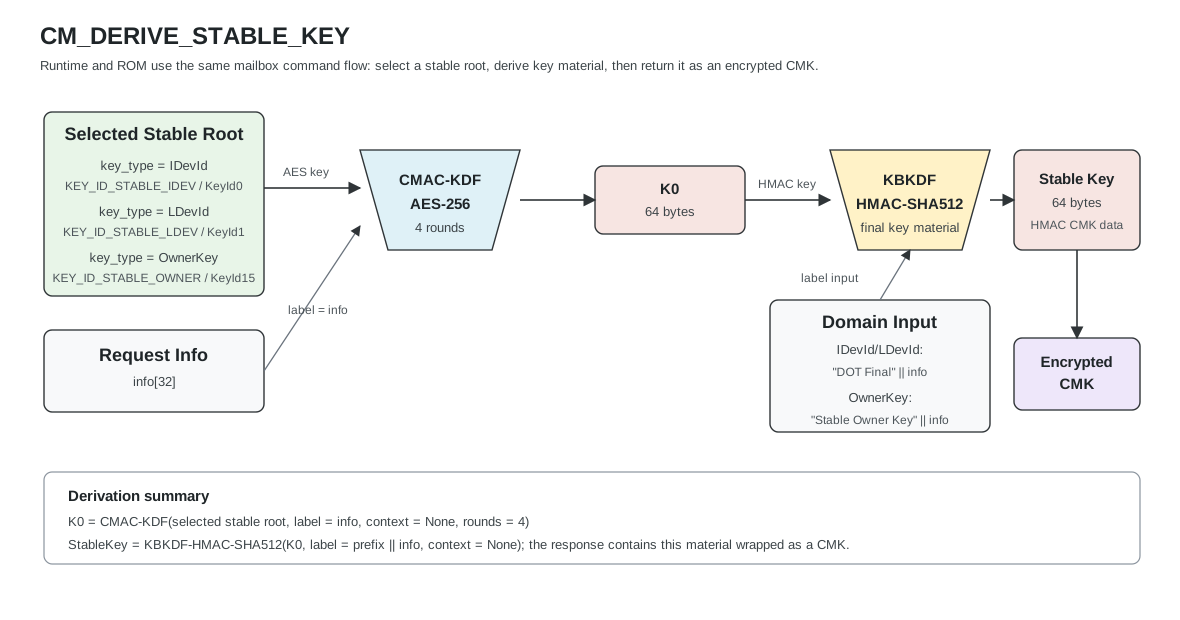
Command Code: 0x434D_4453 ("CMDS")
Table: CM_DERIVE_STABLE_KEY input arguments
| Name | Type | Description |
|---|---|---|
| chksum | u32 | Checksum over other input arguments, computed by the caller. Little endian. |
| key_type | u32 | Source key to derive the stable key from. 0x0000_0001: IDevId 0x0000_0002: LDevId |
| info | u8[32] | Data to use in the key derivation. |
Table: CM_DERIVE_STABLE_KEY output arguments
| Name | Type | Description |
|---|---|---|
| chksum | u32 | Checksum over other output arguments, computed by Caliptra. Little endian. |
| cmk | CMK | CMK that stores the stable key material |
CM_IMPORT
Imports the specified key and returns a CMK for it.
Usage information is required so that the key can be verified and used appropriately.
Note that it is the caller's responsibility to ensure that the source key material meets FIPS requirements, such as zeroization.
Command Code: 0x434D_494D ("CMIM")
Table: CM_IMPORT input arguments
| Name | Type | Description |
|---|---|---|
| chksum | u32 | |
| key usage | u32 | Tag to specify how the data can be used |
| input size | u32 | This MUST agree with the key usage |
| input | u8[input size] |
Table: CM_IMPORT output arguments
| Name | Type | Description |
|---|---|---|
| chksum | u32 | |
| fips_status | u32 | FIPS approved or an error |
| CMK | CMK | CMK containing imported key |
CM_DELETE
Deletes the object stored with the given mailbox ID.
Command Code: 0x434D_444C ("CMDL")
Table: CM_DELETE input arguments
| Name | Type | Description |
|---|---|---|
| chksum | u32 | |
| CMK | CMK | CMK to delete |
Table: CM_DELETE output arguments
| Name | Type | Description |
|---|---|---|
| chksum | u32 | |
| fips_status | u32 | FIPS approved or an error |
CM_CLEAR
The entire contents of the CMK storage is wiped. All known keys will be invalidated.
Command Code: 0x434D_434C ("CMCL")
CM_CLEAR takes no input arguments.
Table: CM_CLEAR output arguments
| Name | Type | Description |
|---|---|---|
| chksum | u32 | |
| fips_status | u32 | FIPS approved or an error |
CM_STATUS
Queries the status cryptographic mailbox system.
The usage storage records the number of entries used and total for for usage tracking. Usage tracking is only currently implemented for AES, so this is is effectively the number of AES keys used and total potential available AES keys.
Command Code: 0x434D_5354 ("CMST")
CM_STATUS takes no input arguments.
Table: CM_STATUS output arguments
| Name | Type | Description |
|---|---|---|
| chksum | u32 | |
| fips_status | u32 | FIPS approved or an error |
| used usage storage | u32 | CMK usage storage (in entries) |
| total usage storage | u32 | Total CMK usage storage (in entries) |
GET_IDEV_ECC384_CSR
Command Code: 0x4944_4352 ("IDCR")
Table: GET_IDEV_ECC384_CSR input arguments
| Name | Type | Description |
|---|---|---|
| chksum | u32 | Checksum over other input arguments, computed by the caller. Little endian. |
Table: GET_IDEV_ECC384_CSR output arguments
| Name | Type | Description |
|---|---|---|
| chksum | u32 | Checksum over other output arguments, computed by Caliptra. Little endian. |
| data_size | u32 | Length in bytes of the valid data in the data field. |
| data | u8[...] | DER-encoded ECC384 IDevID certificate signing request. |
GET_IDEV_MLDSA87_CSR
Command Code: 0x4944_4d52 ("IDMR")
Table: GET_IDEV_MLDSA87_CSR input arguments
| Name | Type | Description |
|---|---|---|
| chksum | u32 | Checksum over other input arguments, computed by the caller. Little endian. |
Table: GET_IDEV_MLDSA87_CSR output arguments
| Name | Type | Description |
|---|---|---|
| chksum | u32 | Checksum over other output arguments, computed by Caliptra. Little endian. |
| data_size | u32 | Length in bytes of the valid data in the data field. |
| data | u8[...] | DER-encoded MLDSA87 IDevID certificate signing request. |
The mfg_flag_gen_idev_id_csr manufacturing flag MUST have been set to generate a CSR.
When called from ROM, if the CSR was not previously provisioned this command will return FW_PROC_MAILBOX_UNPROVISIONED_CSR(0x0102000A).
When called from runtime, if the CSR was not previously provisioned this command will return RUNTIME_GET_IDEV_ID_UNPROVISIONED(0x000E0051). If the ROM did not support CSR generation, this command will return RUNTIME_GET_IDEV_ID_UNSUPPORTED_ROM(0x000E0052).
When the mfg_flag_gen_idev_id_csr flag has been set, the SoC MUST wait for the flow_status_set_idevid_csr_ready bit to be set by Caliptra. Once set, the SoC MUST clear the mfg_flag_gen_idev_id_csr flag for Caliptra to progress.
GET_FMC_ALIAS_ECC384_CSR
Command Code: 0x464D_4352 ("FMCR")
Table: GET_FMC_ALIAS_ECC384_CSR input arguments
| Name | Type | Description |
|---|---|---|
| chksum | u32 | Checksum over other input arguments, computed by the caller. Little endian. |
Table: GET_FMC_ALIAS_ECC384_CSR output arguments
| Name | Type | Description |
|---|---|---|
| chksum | u32 | Checksum over other output arguments, computed by Caliptra. Little endian. |
| data_size | u32 | Length in bytes of the valid data in the data field. |
| data | u8[...] | DER-encoded ECC384 FMC Alias certificate signing request. |
GET_FMC_ALIAS_MLDSA87_CSR
Command Code: 0x464d_4452 ("FMDR")
Table: GET_FMC_ALIAS_MLDSA87_CSR input arguments
| Name | Type | Description |
|---|---|---|
| chksum | u32 | Checksum over other input arguments, computed by the caller. Little endian. |
Table: GET_FMC_ALIAS_MLDSA87_CSR output arguments
| Name | Type | Description |
|---|---|---|
| chksum | u32 | Checksum over other output arguments, computed by Caliptra. Little endian. |
| data_size | u32 | Length in bytes of the valid data in the data field. |
| data | u8[...] | DER-encoded MLDSA87 FMC Alias certificate signing request. |
GET_ATTESTED_ECC384_CSR
Generates an attested ECC384 certificate signing request (CSR) in Entity Attestation Token (EAT) format as per the OCP Device Identity Provisioning specification, signed by the RT Alias key for the requested Device Identity Key, or returns the keypair inventory discovery token when key_id is 0.
Command Code: 0x4145_4352 ("AECR")
Table: GET_ATTESTED_ECC384_CSR input arguments
| Name | Type | Description |
|---|---|---|
| chksum | u32 | Checksum over other input arguments, computed by the caller. Little endian. |
| key_id | u32 | Key ID for which CSR is requested. 0x0000_0000: Keypair inventory discovery 0x0000_0001: LDevId 0x0000_0002: FMC Alias 0x0000_0003: RT Alias |
| nonce | u8[32] | Nonce to be included in the CSR EAT. |
Table: GET_ATTESTED_ECC384_CSR output arguments
| Name | Type | Description |
|---|---|---|
| chksum | u32 | Checksum over other output arguments, computed by Caliptra. Little endian. |
| data_size | u32 | Length in bytes of the valid data in the data field. |
| data | u8[...] | COSE Sign1 signed EAT token containing attested CSR (or keypair inventory when key_id = 0). |
GET_ATTESTED_MLDSA87_CSR
Generates an attested MLDSA87 certificate signing request (CSR) in Entity Attestation Token (EAT) format as per the OCP Device Identity Provisioning specification, signed by the RT Alias key for the requested Device Identity Key, or returns the keypair inventory discovery token when key_id is 0.
Command Code: 0x414D_4352 ("AMCR")
Table: GET_ATTESTED_MLDSA87_CSR input arguments
| Name | Type | Description |
|---|---|---|
| chksum | u32 | Checksum over other input arguments, computed by the caller. Little endian. |
| key_id | u32 | Key ID for which CSR is requested. 0x0000_0000: Keypair inventory discovery 0x0000_0001: LDevId 0x0000_0002: FMC Alias 0x0000_0003: RT Alias |
| nonce | u8[32] | Nonce to be included in the CSR EAT. |
Table: GET_ATTESTED_MLDSA87_CSR output arguments
| Name | Type | Description |
|---|---|---|
| chksum | u32 | Checksum over other output arguments, computed by Caliptra. Little endian. |
| data_size | u32 | Length in bytes of the valid data in the data field. |
| data | u8[...] | COSE Sign1 signed EAT token containing attested CSR (or keypair inventory when key_id = 0). |
SIGN_WITH_EXPORTED_ECDSA
Command Code: 0x5357_4545 ("SWEE")
Note: This command is only available in the locality of the PL0 PAUSER.
Table: SIGN_WITH_EXPORTED_ECDSA input arguments
| Name | Type | Description |
|---|---|---|
| chksum | u32 | Checksum over other input arguments, computed by the caller. Little endian. |
| exported_cdi_handle | u8[32] | The Exported CDI handle returned by the DPE DeriveContext command. Little endian. |
| tbs | u8[48] | The bytes to be signed. Little endian. |
Table: SIGN_WITH_EXPORTED_ECDSA output arguments
| Name | Type | Description |
|---|---|---|
| derived_pubkey_x | u8[48] | The X BigNum of the ECDSA public key associated with the signing key. |
| derived_pubkey_y | u8[48] | The Y BigNum of the ECDSA public key associated with the signing key. |
| signature_r | u8[48] | The R BigNum of an ECDSA signature. |
| signature_s | u8[48] | The S BigNum of an ECDSA signature. |
The exported_cdi can be created by calling DeriveContext with the export-cdi and create-certificate flags.
REVOKE_EXPORTED_CDI_HANDLE
Command Code: 5256_4348 ("RVCH")
Note: This command is only available in the locality of the PL0 PAUSER.
Table: REVOKE_EXPORTED_CDI_HANDLE input arguments
| Name | Type | Description |
|---|---|---|
| chksum | u32 | Checksum over other input arguments, computed by the caller. Little endian. |
| exported_cdi_handle | u8[32] | The Exported CDI handle returned by the DPE DeriveContext command. Little endian. |
The exported_cdi can be created by calling DeriveContext with the export-cdi and create-certificate flags.
The exported_cdi_handle is no longer usable after calling REVOKE_EXPORTED_CDI_HANDLE with it. After the exported_cdi_handle
has been revoked, a new exported CDI can be created by calling DeriveContext with the export-cdi and create-certificate flags.
REALLOCATE_DPE_CONTEXT_LIMITS
Command Code: '5243_5458` ("RCTX")
Note: This command is only available in the locality of the PL0 PAUSER.
Table: REALLOCATE_DPE_CONTEXT_LIMITS input arguments
| Name | Type | Description |
|---|---|---|
| chksum | u32 | Checksum over other input arguments, computed by the caller. Little endian. |
| pl0_context_limit | u32 | Number of contexts to allocate to PL0. PL1 will receive remaining contexts. |
Table: REALLOCATE_DPE_CONTEXT_LIMITS output arguments
| Name | Type | Description |
|---|---|---|
| chksum | u32 | Checksum over other output arguments, computed by Caliptra. Little endian. |
| fips_status | u32 | Indicates if the command is FIPS approved or an error. |
| new_pl0_context_limit | u32 | Number of contexts assigned to PL0 after the reallocation |
| new_pl1_context_limit | u32 | Number of contexts assigned to PL1 after the reallocation |
This allows the user to reallocate the 32 DPE contexts between PL0 and PL1. By default, each gets 16 contexts.
Note: 2 PL0 contexts are used by Caliptra itself during initialization.
Checksum
For every command except for FIRMWARE_LOAD, the request and response feature a checksum. This mitigates glitches between clients and Caliptra.
The checksum is a little-endian 32-bit value, defined as:
0 - (SUM(command code bytes) + SUM(request/response bytes))
The sum of all bytes in a request/response body, and command code, should be zero.
If Caliptra detects an invalid checksum in input parameters, it returns
BAD_CHKSUM as the result.
Caliptra also computes a checksum over all of the responses and writes it to the chksum field.
FIPS status
For every command, the firmware responds with a FIPS status of FIPS approved. There is currently no use case for any other responses or error values.
Table: FIPS status codes
| Name | Value | Description |
|---|---|---|
FIPS_APPROVED | 0x0000_0000 | Status of command is FIPS approved |
RESERVED | 0x0000_0001 - 0xFFFF_FFFF | Other values reserved, will not be sent by Caliptra |
Runtime Firmware updates
Caliptra Runtime Firmware accepts impactless updates that update Caliptra’s firmware without resetting other cores in the SoC.
Applying updates
A Runtime Firmware update is triggered by the FIRMWARE_LOAD command. Upon
receiving this command, Runtime Firmware does the following:
- Locks the mailbox to writes
- Invokes impactless reset
After impactless reset is invoked, FMC loads the hash of the image from the verified Manifest into the necessary PCRs:
- Runtime Journey PCR
- Runtime Latest PCR
If ROM validation of the image fails:
- ROM SHALL NOT clear the Runtime Latest PCR. It SHALL still re-lock this PCR with the existing value.
- FMC SHALL NOT extend either of the Runtime PCRs.
Boot process after update
After an impactless update is applied, the new Runtime Firmware is able to sample a register to determine if it has undergone an Impactless Reset. In this case, the new Runtime Firmware must:
- Validate DPE state in SRAM
- Ensure the TCI tree is well-formed
- Ensure all nodes chain to the root (TYPE = RTMR, “Internal TCI” flag is set)
- Verify that the “Latest TCI” field of the TCI Node that contains the
Runtime PCRs (TYPE = RTMR, “Internal TCI” flag is set) matches the
“Latest” and Journey Runtime PCR values.
- Ensure
SHA384_HASH(0x00..00, TCI from SRAM) == RT_FW_JOURNEY_PCR
- Ensure
- Check that retired and inactive contexts do not have tags
- If any validations fail, Runtime Firmware executes the
DISABLE_ATTESTATIONcommand
DICE Protection Environment (DPE)
Caliptra Runtime Firmware SHALL implement a profile of the DICE Protection Environment (DPE) API.
PAUSER privilege levels
Caliptra uses PAUSER as a HW mechanism to distinguish DPE Client localities. Caliptra models PAUSER callers to its mailbox as having 1 of 2 privilege levels:
- PL0 - High privilege. Only 1 PAUSER in the SoC may be at PL0. The PL0 PAUSER is denoted in the signed Caliptra firmware image. The PL0 PAUSER may call any supported DPE commands. Only PL0 can use the CertifyKey command. Success of the CertifyKey command signifies to the caller that it is at PL0. Only PL0 can use the POPULATE_IDEV_ECC384_CERT and POPULATE_IDEV_MLDSA87_CERT mailbox commands.
- PL1 - Restricted privilege. All other PAUSERs in the SoC are PL1. Caliptra SHALL fail any calls to the DPE CertifyKey with format=X509 by PL1 callers. PL1 callers should use the CSR format instead.
PAUSER and Locality map 1:1. Consequently, only the single DPE Client associated with PL0 level, is authorized to invoke CertifyKey DPE command with format=x509. All other DPE Clients have instead restricted privileges associated to PL1 (as described above).
PAUSER privilege level active context limits
Each active context in DPE is activated from either PL0 or PL1 through the InvokeDpe mailbox command calling the DeriveContext or InitializeContext DPE commands. However, a caller could easily exhaust space in DPE's context array by repeatedly calling the aforementioned DPE commands with certain flags set.
To prevent this, we establish active context limits for each PAUSER privilege level:
- PL0 - 16 active contexts
- PL1 - 16 active contexts
If a DPE command were to activate a new context such that the total number of active contexts in a privilege level is above its active context limit, the InvokeDpe command should fail.
At boot Caliptra Runtime FW consumes part of the PL0 active contexts (initially 16) to DeriveContext for:
- RTFW Journey (RTFJ) Measurement (1)
- Caliptra Configured Initialization Values digest (CCIV) (1)
- ROM Stashed Measurements (max 8)
Further, it is not allowed for PL1 to call DeriveContext with the intent to change locality to PL0's locality; this would increase the number of active contexts in PL0's locality, and hence allow PL1 to DOS PL0.
DPE profile implementation
The DPE iRoT profile leaves some choices up to implementers. This section describes specific requirements for the Caliptra DPE implementation.
| Name | Value | Description |
|---|---|---|
| Profile Variant | DPE_PROFILE_IROT_P384_SHA384 | The profile variant that Caliptra implements. |
| KDF | SP800-108 HMAC-CTR | KDF to use for CDI (tcg.derive.kdf-sha384) and asymmetric key (tcg.derive.kdf-sha384-p384) derivation. |
| Simulation Context Support | Yes | Whether Caliptra implements the optional Simulation Contexts feature. |
| Supports ExtendTci | Yes | Whether Caliptra implements the optional ExtendTci command. |
| Supports Auto Init | Yes | Whether Caliptra will automatically initialize the default DPE context. |
| Supports Rotate Context | Yes | Whether Caliptra supports the optional RotateContextHandle command. |
| CertifyKey Alias Key | Caliptra Runtime Alias Key | The key that will be used to sign certificates that are produced by the DPE CertifyKey command. |
Supported DPE commands
Caliptra DPE supports the following commands:
- GetProfile
- InitializeContext
- DeriveContext
- Note: The "export-cdi" flag is only available in the locality of the PL0 PAUSER.
- CertifyKey
- Caliptra DPE supports two formats for CertifyKey: X.509 and PKCS#10 CSR. X.509 is only available to PL0 PAUSERs.
- Sign
- RotateContextHandle
- DestroyContext
- GetCertificateChain
DPE state atomicity
This implementation guarantees that no internal DPE state is changed if a command fails for any reason. This includes context handle rotation; single-use context handles are not rotated if a command fails.
On failure, DPE only returns a command header, with no additional command-specific response parameters. This is in line with the CBOR-based main DPE spec, which does not return a response payload on failure.
Initializing DPE
Caliptra Runtime Firmware is responsible for initializing DPE’s default context.
- Runtime Firmware SHALL initialize the default context in “internal-cdi” mode.
- Perform the following initial measurements:
- Call DeriveContext with Caliptra RT PCRs
- INPUT_DATA = PCRX (RT journey PCR as defined in the FHT)
- TYPE = “RTMR”
- CONTEXT_HANDLE = default context
- TARGET_LOCALITY = Caliptra locality (0xFFFFFFFF)
- Call DeriveContext with hash of initialization values below
- INPUT_DATA = Hash of:
- CPTRA_VALID_PAUSER register
- PL0 PAUSER locality
- Flags from FW image manifest header
- FMC load address
- FMC entry point
- Runtime load address
- Runtime entry point
- TYPE = "CCIV"
- CONTEXT_HANDLE = default context
- TARGET_LOCALITY = PL0 PAUSER
- INPUT_DATA = Hash of:
- Call DeriveContext for each STASH_MEASUREMENT call made during Caliptra ROM execution
- INPUT_DATA =
measurementparameter to STASH_MEASUREMENT - TYPE =
typeparameter to STASH_MEASUREMENT - CONTEXT_HANDLE = default context
- TARGET_LOCALITY = PL0 PAUSER
- INPUT_DATA =
- Call DeriveContext with Caliptra RT PCRs
CDI derivation
The DPE Sign and CertifyKey commands derive an asymmetric key for that handle.
DPE first collects measurements and concatenates them in a byte buffer,
MEASUREMENT_DATA:
- LABEL parameter passed to Sign or CertifyKey.
- The
TCI_NODE_DATAstructures in the path from the current TCI node to the root, inclusive, starting with the current node.
To derive a CDI for a given context, DPE shall use KeyVault hardware with the following inputs:
- CDI = Runtime Firmware CDI (from KeyVault)
- Label = LABEL parameter provided to Sign or CertifyKey
- Context =
MEASUREMENT_DATA
The CDI shall be loaded into KeyVault slot 8.
Leaf key derivation
To derive an asymmetric key for Sign and CertifyKey, Runtime Firmware does the following:
- Derives an ECC P384 keypair from KV slot 8 CDI into KV slot 9
- For CertifyKey: Requests the public key
- For Sign: Signs passed data
- Erases KeyVault slots 8 and 9
Internal representation of TCI nodes
| Byte offset | Bits | Name | Description |
|---|---|---|---|
| 0x00 | 383:0 | TCI_CURRENT | Current TCI measurement value |
| 0x30 | 383:0 | TCI_CUMULATIVE | TCI measurement value |
| 0x60 | 31:0 | TYPE | TYPE parameter to the DeriveContext call that created this node |
| 0x64 | 31:0 | LOCALITY | TARGET_LOCALITY parameter to the DeriveContext call that created this node (PAUSER) |
Certificate generation
The DPE Runtime Alias Key SHALL sign DPE leaf certificates and CSRs.
The DPE GET_CERTIFICATE_CHAIN command shall return the following certificates:
- IDevID (optionally added by the SoC via POPULATE_IDEV_ECC384_CERT)
- LDevID
- FMC Alias
- Runtime Alias
DPE leaf certificate definition
| Field | Sub field | Value |
|---|---|---|
| Version | v3 | 2 |
| Serial Number | First 20 bytes of sha256 hash of DPE Alias public key | |
| Issuer Name | CN | Caliptra Runtime Alias |
| serialNumber | First 20 bytes of sha384 hash of Runtime Alias public key | |
| Validity | notBefore | notBefore from firmware manifest |
| notAfter | notAfter from firmware manifest | |
| Subject Name | CN | Caliptra DPE Leaf |
| serialNumber | SHA384 hash of Subject public key | |
| Subject Public Key Info | Algorithm | ecdsa-with-SHA384 |
| Parameters | Named Curve = prime384v1 | |
| Public Key | DPE Alias Public Key value | |
| Signature Algorithm Identifier | Algorithm | ecdsa-with-SHA384 |
| Parameters | Named Curve = prime384v1 | |
| Signature Value | Digital signature for the certificate | |
| KeyUsage | keyCertSign | 1 |
| Basic Constraints | CA | False |
| Policy OIDs | id-tcg-kp-attestLoc | |
| tcg-dice-MultiTcbInfo* | FWIDs | [0] "Current" TCI Value. Latest INPUT_DATA made by DeriveContext |
| IntegrityRegisters | [0] "Journey" TCI Value. | |
| Type | 4-byte TYPE field of TCI node | |
| VendorInfo | Locality of the caller (analog for PAUSER) |
*MultiTcbInfo contains one TcbInfo for each TCI Node in the path from the current TCI Node to the root. Max of 32.