Caliptra MCU Certificate Store
Purpose and scope
This document defines the protocol-neutral behavior of the Caliptra MCU certificate store. It describes the store's runtime contract, certificate composition, persistence guarantees, and transport boundaries.
The trust model and certificate-chain contents are defined in the Caliptra Certificate Model. The in-field provisioning workflow is defined in In-field Certificate Provisioning and Management.
For concrete platform configuration steps, see Certificate Store Integration.
Implementation status
This document defines the target release behavior. The current source implements ECC P-384 Vendor certificate-chain retrieval through SPDM. Managed Owner and Tenant slots are test-only. Common certificate-store initialization, the Vendor IDevID certificate provider, ML-DSA-87 certificate chains, MCI certificate commands, and configurable Tenant SlotIDs are planned. Production authorization and managed-backing contracts are deferred.
Certificate store overview
The target architecture provides one protocol-neutral certificate store shared by all enabled SPDM and MCI mailbox responder tasks. The store supports ECC P-384 and planned ML-DSA-87 certificate chains in Vendor, Owner, and Tenant certificate slots. A static platform profile determines which optional slots are enabled and whether the store uses the classical-only or classical-plus-PQC algorithm profile.
Supported certificate algorithms are:
- ECC P-384, which is always enabled.
- ML-DSA-87, which is planned and enabled explicitly by the platform profile.
Supported certificate slots are:
- Vendor.
- Owner.
- Tenant.
When planned ML-DSA-87 support is enabled, every enabled certificate slot is configured with both an ECC P-384 chain and an independent ML-DSA-87 chain. For example, Owner ECC P-384 and Owner ML-DSA-87 have separate certificate data, lifecycle state, and persistent backing.
SPDM SlotIDs and the planned MCI command fields are transport-specific identifiers. They are mapped to the corresponding certificate chain before the common store is accessed.
Runtime architecture
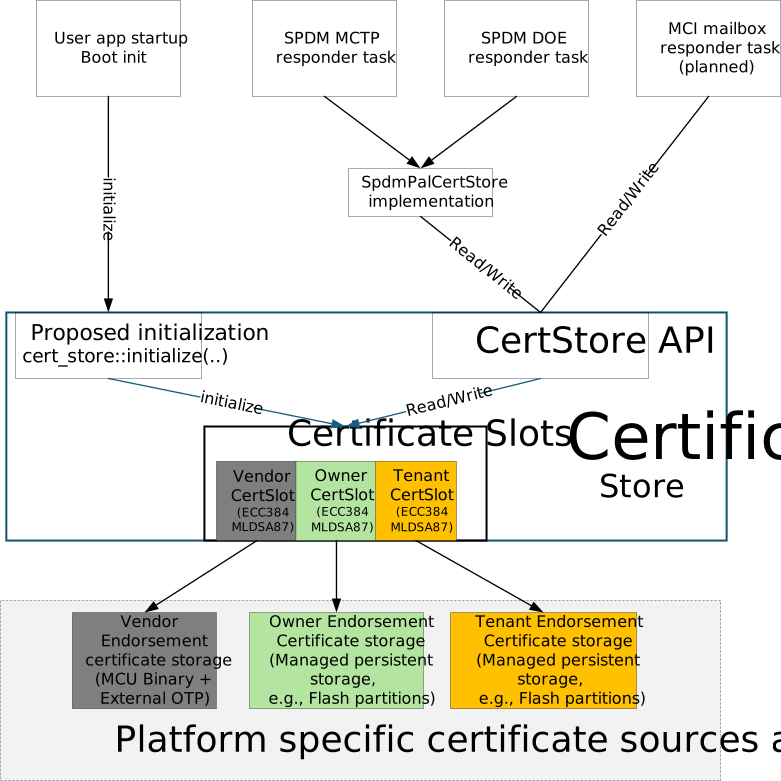
The diagram shows the target release architecture. The current implementation
initializes SharedCertStore from the SPDM module. The common initialization,
ML-DSA-87, MCI, and configurable Tenant elements shown in the diagram are
planned.
The proposed initialization module is part of CertStore and exposes a
one-time cert_store::initialize(...) API. The user application will call
this API from its startup boot_init() path. The proposed API:
- Applies the static platform certificate-store profile.
- Obtains the complete IDevID certificate for each provisioned algorithm from
the proposed platform
VendorIdevidCertificateProvider. - Recovers provisioned Owner and Tenant endorsements from their configured persistent backing.
- Determines which ECC P-384 and ML-DSA-87 certificate chains are available.
- Makes the store available to the responder tasks.
Initialization SHALL fail unless the Vendor ECC P-384 chain is provisioned and available. Failure to initialize any other configured algorithm-and-slot chain leaves only that chain unavailable and does not fail common initialization.
A managed chain with accessible backing but no committed endorsement is unprovisioned. A chain that cannot initialize because its anchor point, certificate or signing capability, endorsement source, or backing is unavailable is marked unavailable. Both states are excluded from the provisioned-chain advertisement, and the initialization failure is reported for platform diagnostics.
The target release starts the SPDM MCTP, SPDM DOE, and planned MCI mailbox
responder tasks only after the proposed initialization API succeeds. The SPDM
responder tasks access the store through the existing SpdmPalCertStore
implementation. The planned MCI mailbox command handler calls the common
certificate-store API directly.
The common store represents each logical algorithm-and-certificate-slot
combination as a CertSlot. These logical certificate slots are independent
of SPDM SlotIDs.
Each enabled certificate transport accesses the same CertStore instance.
An endorsement update through one transport is visible to all other enabled
certificate transports.
Certificate slot behavior
The certificate store applies these slot semantics after initialization:
| Certificate slot | Certificate-store behavior |
|---|---|
| Vendor | Mandatory and read-only. Its PKI anchor point is the manufacturing IDevID, and it is configured to support every algorithm selected by the global profile. Only failure of its ECC P-384 chain is fatal to common initialization. |
| Owner | Optional managed endorsement. It is configured to support every algorithm selected by the global profile, with independent availability, lifecycle, and persistent backing for each algorithm. |
| Tenant | Optional managed endorsement, independent from Vendor and Owner. It is configured to support every algorithm selected by the global profile, with independent availability, lifecycle, and persistent backing for each algorithm. |
The Vendor endorsement certificates are established during manufacturing and remain read-only for the device lifetime. They cannot be provisioned, replaced, or removed at runtime. Owner and Tenant provisioning requires authorization.
Certificate-chain composition
For each available certificate slot, the store obtains:
- Caliptra device certificates below the configured PKI anchor point.
- The generated DPE leaf certificate.
The common store composes these sources in root-to-leaf order:
complete chain =
    PKI endorsement
    + Caliptra device certificates below the PKI anchor point
    + generated DPE leaf certificate
Provisioning changes only the PKI endorsement. The generated Caliptra and DPE certificates remain owned by the Caliptra certificate services.
Certificate signing remains outside the common store. The certificate and signing services ensure that the generated leaf certificate and selected signing key represent the same active identity.
Managed endorsement backing
Managed Owner and Tenant endorsements use platform-provided persistent backing. Each enabled algorithm-and-slot endorsement has independent backing.
The configured size is the maximum number of DER bytes accepted for the provisioned PKI endorsement. It does not include the generated Caliptra and DPE certificates used to compose the complete chain.
The backing may require additional space for implementation metadata and atomic updates. ECC P-384 and ML-DSA-87 endorsements SHALL NOT share the same managed certificate region.
ML-DSA-87 chains are roughly an order of magnitude larger than ECC P-384
ones, so a composed ML-DSA-87 chain can exceed the 64 KiB addressable by the
pre-1.4 GET_CERTIFICATE form. SPDM 1.4 widens the certificate-chain
Length field to 32 bits by absorbing the adjacent Reserved field, so
oversized chains are served to a 1.4 requester that uses LargeCertChain. A
1.4 requester that asks for an oversized chain without LargeCertChain
receives CertChainTooLarge carrying the actual size and can retry; below
1.4 the chain is not retrievable at all.
The certificate store provides these externally visible guarantees:
- A replacement endorsement does not become active until it is completely received, validated, and committed.
- The previous endorsement remains readable while a replacement is in progress.
- Reset or power loss does not expose a partial endorsement.
- Removal is durable.
- Recovery selects a complete committed endorsement or an unprovisioned state.
The certificate store does not require a particular flash layout or persistent record format.
Shared runtime behavior
All enabled transports observe the same published state for each certificate chain.
Reads return the complete chain. Provisioning operations accept only the PKI endorsement. Provisioning cannot modify the configured device key, generated certificate path, DPE leaf certificate, or private key.
Updates to different certificate keys are independent. An update to an Owner ECC P-384 endorsement does not block or modify Owner ML-DSA-87, Vendor, or Tenant state.
Readers receive a consistent certificate chain while an update is in progress. Publication changes the active endorsement atomically for subsequent operations.
These consistency guarantees do not require a reader-writer lock or another
particular synchronization primitive. Synchronization is internal to the
common store and is not exposed to the SpdmPalCertStore implementation or
the planned MCI mailbox command handler.
Certificate algorithm requirements
ECC P-384
The ECC P-384 chain for each enabled endorsement role requires:
- Its PKI endorsement source or managed backing.
- An ECC P-384 generated certificate path.
- An ECC P-384 DPE leaf certificate.
- Access to the corresponding ECC P-384 signing key.
ML-DSA-87 (planned)
The ML-DSA-87 chain for each enabled endorsement role requires:
- Its own PKI endorsement source or managed backing.
- An ML-DSA-87 generated certificate path.
- An ML-DSA-87 DPE leaf certificate.
- Access to the corresponding ML-DSA-87 signing key.
ML-DSA-87 certificate data and storage are independent from ECC P-384. An ML-DSA-87 chain remains unavailable until every component required for its complete chain and signing operation is present.
Enabling ML-DSA-87 is independent of the configured SPDM protocol version. SPDM 1.4 negotiates either ECC P-384 or ML-DSA-87 for a connection; it does not use both algorithms together. The certificate store does not define SPDM post-quantum protocol negotiation or message encoding.
SPDM integration
The SpdmPalCertStore implementation:
- Maps the negotiated certificate algorithm and SPDM SlotID to a certificate chain.
- Advertises only certificate chains available through SPDM.
- Obtains complete chains from the common store.
- Sends authorized endorsement updates to the common store.
SPDM SlotID policy is defined in In-field Certificate Provisioning and Management. SPDM message formats are defined by the SPDM specifications.
MCI integration (planned)
The planned MCI mailbox command handler:
- Validates the requested certificate algorithm and
EndorsementRole. - Calls the
CertStoreAPI for complete-chain reads. - Calls the common authorization and
CertStoreAPIs for endorsement updates. - Exposes only certificate chains available through MCI.
MCI will not use SPDM SlotIDs. The reserved command codes are documented in External Mailbox Commands; command formats and handlers remain planned.
Authorization boundary
Vendor endorsements are never writable. Owner and Tenant updates reach the certificate store only after the requester and requested operation have been authorized.
The production authorization credential format, policy, and lifecycle are deferred and defined separately from the certificate store. The target design uses the same transport-independent authorization content for SPDM and MCI; only their outer transport framing differs.